
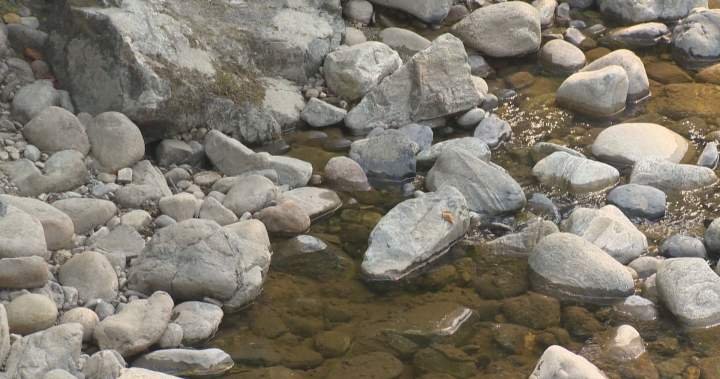

Snowpack in the Okanagan is at its lowest level in at least four decades.

Newly released data from the BC River Forecast Center shows a stark contrast across B.C. While the northern and eastern regions are above normal, the Okanagan is only at 58 percent, a record low since tracking began in 1980.
“Of particular note, the Okanagan had several very long-term stations at all-time record low readings for April 1,” said Jonathan Boyd, a hydrologist with the BC River Forecast Centre.
Since we have a historical record of snow basin indices that start around 1980, that was the lowest snow basin index for the Okanagan at 58 percent of normal and the previous one was 1981 at 67 percent. So the Okanagan in particular is an area that highlights how extremely low it is this year compared to previous years.”
The chair of the Okanagan Basin Water Board says as drought fears grow, so does planning as the region prepares for what could be a very dry summer.

Get daily national news
Get Canada’s daily news delivered to your inbox so you never miss the top news of the day.
“Everybody’s talking about it,” said Blair Ireland with the Okanagan Basin Water Board.
“Every community is looking at how they’re going to put water restrictions or what they’re going to do to deal with this drought.”

A limited water supply can significantly affect daily life and have far-reaching impacts on agriculture, tourism and the environment.
“Typically, what snow acts like is, it’s like a savings account and it’s something that basically stores that moisture to be released later in the season,” Boyd said.
“And if we have it all now, that could mean we’re in a deficit once we get into the later spring in June or summer.”
While a low snowpack is a concern, it’s the amount of moisture in the coming weeks that will really be the deciding factor.
“Snowpack alone doesn’t necessarily guarantee drought one way or the other,” Boyd said. “Overall spring and summer weather conditions are really indicative of whether drought occurs or not.”
With spring’s potential to bring heavy rainfall, there’s still a chance Mother Nature can help avert a drought disaster.
“I don’t have rain boots,” said Ireland.
“But I don’t care. I want to see rain. I think we all do.”
© 2026 Global News, a division of Corus Entertainment Inc.



