
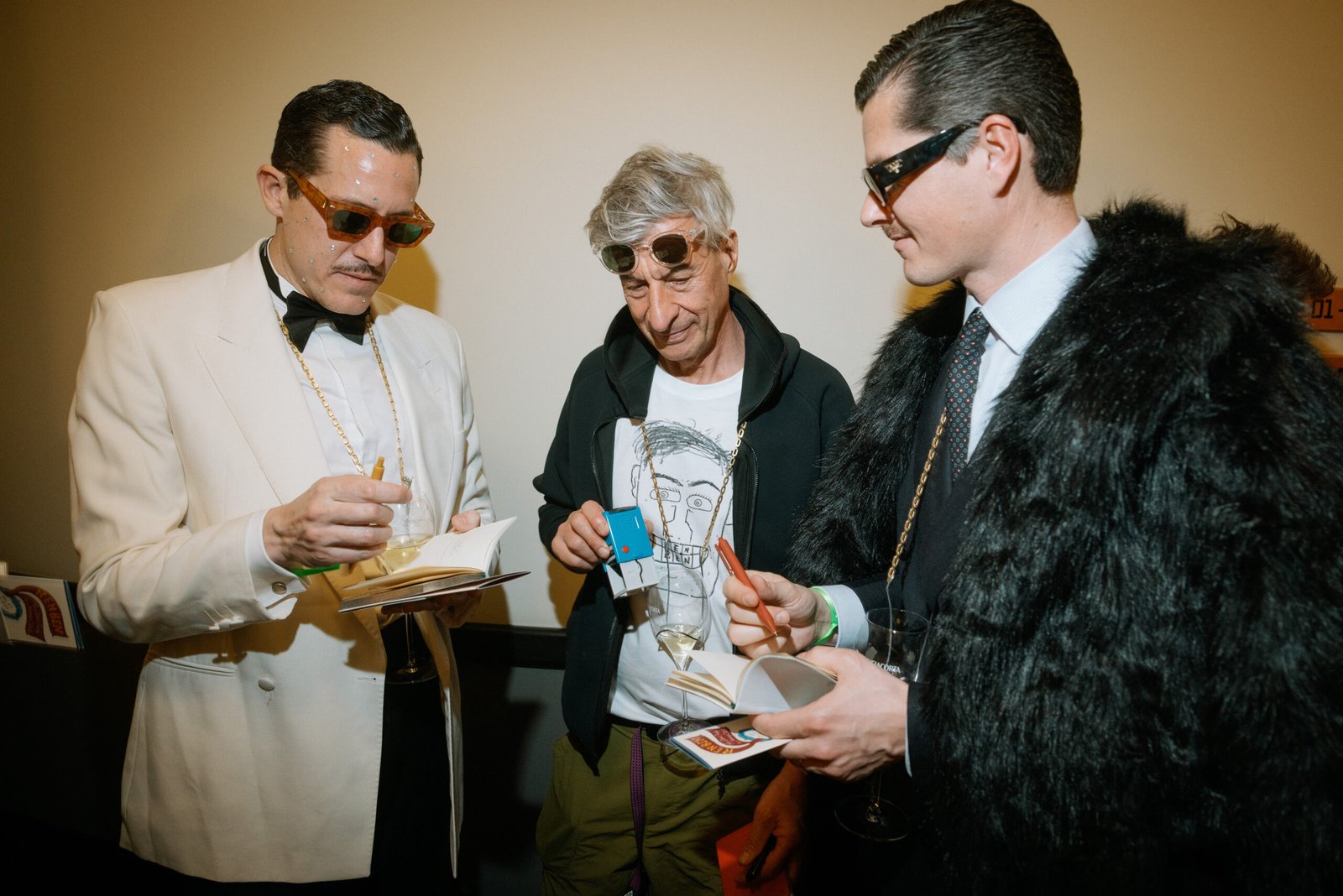


What a blessing to have silence not only available, but imposed at an art event—to finally be able to focus on the art experience without the distraction of social interaction. For a writer like myself, who hopes for exactly that state every time I visit a show, this year’s Chicago Renaissance Society gala was just perfect. “Many events confuse noise with energy and I wanted to undo this confusion,” the artist Maurizio Cattelanwho designed the event, tells me, adding that silence changes the way people perceive things. “It’s not that communication stops altogether; it just becomes less efficient and more exposed. People write, wait, look longer.” To him, it felt like a good premise for an art event, though he admitted that many artists have engaged with silence far better than he ever did, from John Cage THE Joseph Grigely. “I wasn’t trying to make a statement so much as interrupt an automatic behavior. A gala usually runs on social reflex, and silence makes that reflex visible.”
Only a provocateur like Cattelan could turn the legendary RenBen gala—which this year raised nearly $600,000 in support of the museum’s exhibitions, performance series, concerts, and public programs, all of which remain free and open to the public—into its own work of art: a silent scavenger hunt, a collective show, and a collective performance. In its final act, the evening turned again into something resembling an Italian wedding party, or sagra, those whole country parties that dissolve the distinctions between host and guest.

“A solo show is already full of other people. Assistants, references, ghosts, interruptions,” says Cattelan, clarifying that the evening would have been nothing without the sum of its parts. Many of the artists involved were related to Ren; some created situations in which guests could interact and take something away. “The game was simple: give guests a structure, then let them get a little lost within it.”
Taking in two floors of the Chicago Athletic Association’s historic downtown architecture, Cattelan choreographed a journey through the rooms that brought a smile to each of the evening’s 400 guests. Silent films, stills – the works can be his or simply left there. The rooms felt like abandoned hotel interiors: a crime scene, or the footprints of someone who suddenly disappeared. “Exhibition space left as is,” reads one of the scripts on one screen. Bottles of Franciacorta were served from a tub. Silent waiters nodded to guests to offer Midwest cicchetti, guests bowed in thanks—a silent social ritual that becomes, in itself, a spectacle.
One screen projected an “urgent prayer” to donate to the institution, highlighting this too as a “fun” moment, encouraging us to find joy in it. “Art should make you feel; Art should make you think, And REN will give you the opportunity to realize that the Renaissance never ended,” it says. Next to her sat a classic church donation box. One room appeared to be under renovation, covered with transparent plastic sheets. In another, a corpse-like video lays like seaweed on a beach. The gala was a maze ride – people moved through it like children exploring, eventually arriving at a room filled with balloons, like a maze.

A room for Polaroids turned every visitor into the protagonist of the show. In another, a magical card game unfolds wordlessly. In another, a skeleton animated by the Turkish artist Özgür Snow appears on a screen. A series of silent films selected from Dan Morgan AND Allyson Field it reminds us of the narrative and expressive power of early silent cinema. Elsewhere, visitors are invited to slow down and view art slides as if in a lecture. Then there’s a man wearing headphones playing guitar in a kind of trance, making, wordlessly, a quiet statement: sometimes the inner world is bigger than what we perform for others. Nearby, Sigmund Freud is strangely evoked Isadora Neves Marquesvideo of The early death of Sigmund Freud. In one of the final rooms, a screen reads “your tongue on your partner’s wrist” as three performers act it out in a piece conceived by David Balulauntil a short circuit displaces the current.
Cattelan’s staging unfolds over two floors as a psychological, imaginative, inward-looking labyrinth. His ban on conversation forced gala attendees to focus on the experience, removing that layer of social performance that so often distracts from art encounters. And then, near the end, a white canvas with a golden toilet appears – the only unmistakable Katelanian gesture.

In her speech, the president of the board of the Renaissance Society Nancy Lenner Frey described the evening as an “act of persistence and resistance to speed and noise”. Ironically, as the crowd gathered in Stagg Court, Executive Director and Chief Curator Mariam Ben Salah had to call for silence—almost shouting at a crowd that, freed from an hour and 30 minutes of enforced silence, suddenly became irrepressible, immediately resuming its social performance.
Humor is not the opposite of seriousness, but a way to maintain it, she said, referring to Cattelan’s artistic practice. “Being off-beat or off-track” is a blessing, she added – before going on to reveal a long list of artists who participated in Cattelan’s choreography, including Isabelle Frances McGuire, Josh Dihle, Alejandro Cesarco, Max Guy, His shirt, Jacob Ryan Reynolds, Ghislaije Keunmin, William ChurchillPeter Wachtler and Özgür Kar.
Then the mood changed. The music started and the crowd started dancing to the Italian folk songs played by La Tosca. Dinner was served in the style of a sala veneziana ballroom: a tricolor salad and a lemon risotto, the menu conceived by Jason Hammel at Lula Cafe. To top it off, a 3.5 meter tall tiramisu appeared – very good, it must be said – as Venetian as Maurizio himself, who has lived in Treviso.

Only Cattelan could turn the gala of an American institution into an Italian wedding; that moment of the ballerina, the ballroom as a true ritual of collectivity that perhaps we all miss. “I’m not sure it was all that Italian. Have you ever known Italians to keep their mouths shut?” Cattelan notes slyly. When asked for three words to describe the evening, he offers ritual, awkwardness and release. “Ritual, because people need shape before they lose shape,” he explains. “Embarrassment, because embarrassment makes you self-aware. It’s a very honest medium. Let go, because pleasure really only comes after restraint.” Italians, he adds, know that the line between mourning and celebration is very thin. “It helps,” he says.
When I asked Ben Salah how she sees her role, she says that her main priority is to keep artists at the center while recognizing that institutions don’t run on ideals alone. “Being a curator also means fundraising, hosting, persuading, producing and solving problems. I don’t regret it. In fact, I find some of it really interesting and even fulfilling in its own way,” she admits, stressing that all those functions should remain at the service of the artistic project rather than away from it.
Throwing a fundraiser every year is not, a priori, her favorite thing in the world – which is why she decided to turn it into an artist-led project. “We’re lucky to work with some of the most creative people around, so why would we hand over our biggest annual event to a corporate events company when we can use it as another space for experimentation? That shift changed everything for me,” she says, noting that while raising 25 percent of their annual budget in a single night isn’t exactly easy, it becomes more enjoyable for an artist when rooted in vision.
Chicago, according to Ben Salah, is defined by two very different but equally vital energies: on the one hand, its venerable institutions like the Art Institute and the MCA, and on the other, its artist-run spaces, apartment galleries and deeply vibrant DIY scene. “I think Ren has always occupied a very special place between those two poles, and we’re happy to live in that space in between. We’re not an artist-run space, but we’re not a perfectly painted institution either. We’ve tried to retain some of the scratch, flexibility and sweat of the former while providing the support of the latter.”
Ben Salah admits that aligning RenBen with EXPO has been a real game changer. “It has transformed the kind of audience the event can gather, bringing artists, curators, collectors and friends from all over into the same room, and has allowed us to create meaningful synergies not only with the fair itself, but with the wider constellation of people and institutions that make it such an energetic week for the city,” she concludes. And if RenBen is the energy test for the city’s art week, Chicago felt more than ready, filled with the intensity of a Gilded Age in full swing.




