
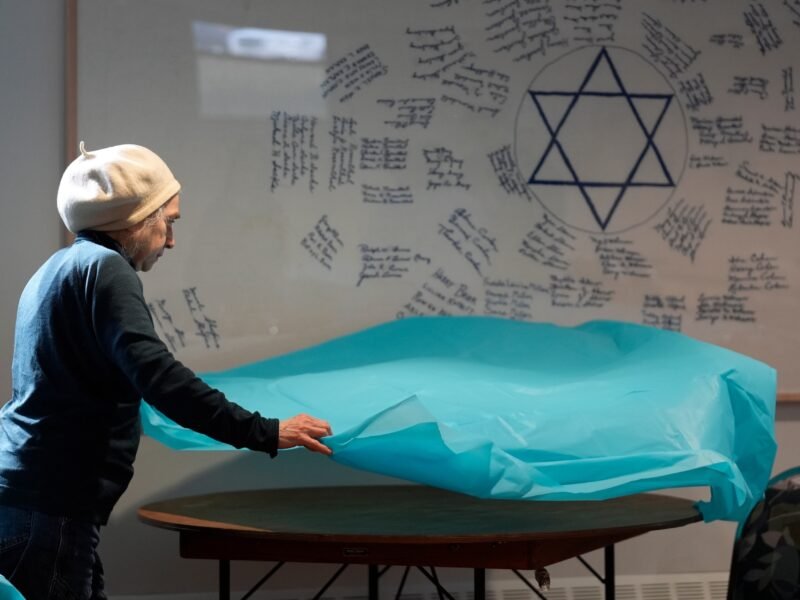

WATERVILLE, Maine (AP) — Rabbi Rachel Isaacs spent the days ahead Passover overseeing the preparation of ceremonial meals at Congregation Beth Israel, a synagogue in central Maine where membership has quadrupled over the past 15 years.
These days, growing congregations are very much on Isaacs’ mind, as she leads a movement to strengthen rural synagogues and Jewish communities across the country. They have reached dozens and hope for many more.
“Rural Jewish life is important to the Jewish people and it’s important to rural America,” Isaacs said. “These people deserve to be served and shepherded.”
Isaacs is executive director of the Center for Small Town Jewish Life at Colby College, a liberal arts school in Waterville, Maine. The center began a decade ago with the goal of supporting Jewish congregations far from major cities and has grown to run programs for more than 60 communities in 22 states.
Just under 2.4% of Americans are Jewish. Of those million people, one in eight live outside a major urban area, and the center exists to help them thrive, Isaacs said.
The center’s work is taking place at a vital time, as there are roughly 20% fewer synagogues in America than there were in 1990, according to data compiled by Alanna E. Cooper, a professor of Jewish studies at Case Western Reserve University in Ohio. The trend is even more pronounced in rural America, where population aging and displacement have hit congregations hard.
Outreach to rural synagogues is also happening as Jewish Americans face a the rising tide of anti-Semitism and violent attacks against Jewish communities. The Anti-Defamation League noted a nearly 900% increase in anti-Semitic incidents for the decade ending in 2024. Some of the states with a high rate of incidents include mostly rural states like Maine, New Hampshire and Wyoming, the ADL report said.
The center’s work could help reverse that trend, Isaacs said.
“You have more Jews experiencing joy, who can find the strength, make connections with other Jews across the country and around the world,” Isaacs said. “In a world of rising anti-Semitism, it is ever more important that Jewish communities are joyful, strong and connected.”
Since its inception, the center has helped congregations from Maine to California, Montana and Texas.
From Maine to Montana
Isaacs is also the rabbi at Beth Israel, a centuries-old synagogue down the street from Colby that is the only one within 20 miles of the college. The synagogue has grown along with the center, but the work of the Center for Small Town Jewish Life extends far beyond Maine, she said.
And congregations that have relied on the center said its contributions are vital in a country where the Jewish population has been overwhelmingly urban since the early days of immigration. In Helena, Montana, Rebecca Stanfel, executive director of the Montana Jewish Project, said the center was important in helping unite the relatively small Jewish community in her vast state.
Connecting far-flung faith communities is extremely important in a place like Montana, Stanfel said.
“In Helena, we have no choice but to rely on volunteers. And if we want to have something like a seder, the High Holidays, it has to come from the community,” Stanfel said. “This is also a really important model for people outside of rural America.”
A plan to help
The center assists congregations through three strategies designed to foster rural synagogues. One is Makom, a two-year mentoring program for rabbis serving in rural synagogues.
Another trains lay leaders to lead prayers and support congregations, which helps them thrive without a full-time rabbi. The third is board leadership training, which trains synagogue presidents and boards in how to manage small-town Jewish institutions.
Rabbi Lisa Rapaport, who leads Congregation Beth Israel in Chico, California, was among the first to go through the Makom program. Rural rabbis often lead the only Jewish congregation in town, and that makes the job “special and beautiful and challenging,” she said.
Strengthening rural communities
The Makom scholarship program elevates rural rabbis to this challenge, Rappaport said.
“We’ve felt very valued as rabbis in small communities that our work is just as important,” she said.
In Waterville, volunteers ranging from Colby students to retirees were preparing to host about 100 people for Easter. It may be a small community, but it’s a strong and loving community, said Jeff Lovitz, a synagogue member, as he folded napkins.
“We’ve been here since the early ’70s. Our kids went to Hebrew school here,” he said. “I think it’s important to have a Jewish community in Waterville.”
__
By PATRICK WHITTLE Associated Press
Subscribe to our free newsletters
Our weekly newsletter Closing arguments provides the latest on ongoing trials, major litigation and decisions in courts around the US and the world, while monthly Under the lights feeds legal dirt from Hollywood, sports, Big Tech and the arts.



