
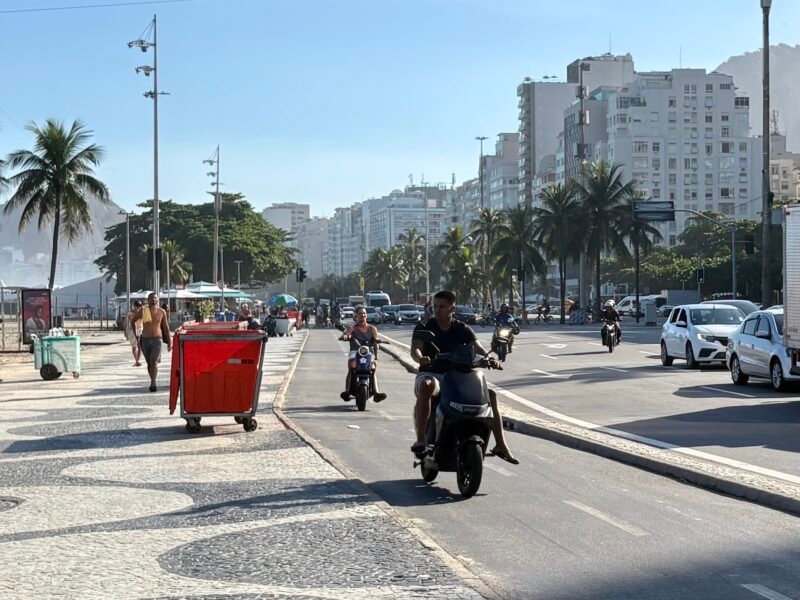

RIO DE JANEIRO (CN) – Stefany Correia Cesario, a 30-year-old resident of Vidigal in the southern area of Rio de Janeiro, was driving her electric two-wheeler in a bike lane on her way to her job at a beach kiosk in Copacabana on Tuesday morning when municipal agents stopped her.
“He told me to go to the street,” she said. “I said no, sir, I don’t feel safe, it’s too dangerous.”
The ban was among the first under Decree 57823, published by Rio City Hall on Monday and effective immediately. town described it as the first such regulation adopted by a Brazilian capital for electric micro-mobility vehicles.
The changes include banning these vehicles from bike lanes, requiring helmets for all riders and reclassifying some of them as motorcycles – a move that, in effect, makes them subject to registration, plates and driver’s licenses.
The decree was released a week after a woman and her son were killed when a bus hit them while riding an electric two-wheeler, and four months after a federal resolution on those vehicles took effect.
In force since January 1, Resolution 996/2023 of Brazil’s National Traffic Council, known as Contran, defined the categories of motorcycles, electric bikes and self-propelled individual mobility devices, establishing criteria such as power, maximum speed and use of throttle.
According to federal regulations, electric bicycles are only those with pedal assist and no throttle. Self-propelled devices are limited to 1000 watts and about 20 mph, while motorcycles can have electric motors of up to 4 kilowatts and a top speed of about 31 mph. Unlike self-propelled devices, motorcycles require registration, license plates, a driver’s license and a helmet.

Potential legal conflict
Gustavo Justino de Oliveira, a professor of administrative law at the University of São Paulo, said Brazil’s Constitution gives the federal government exclusive authority to legislate on traffic and transportation, while municipalities have a narrower role focused on regulating traffic on roads under their control.
“This Rio decree seems to violate some rules,” Oliveira said. “It changes some classifications and creates opportunities that are not foreseen in the federal resolution. Rio de Janeiro is creating a regulation that is innovative and, at times, goes against the Contran resolution.”
But André Rodrigues Cyrino, an associate professor of administrative law at the State University of Rio de Janeiro, said that while traffic legislation falls under the exclusive authority of the federal government, Brazil’s Traffic Code allows municipalities to decide some issues, especially those related to local traffic.
“Defining, for example, what a bike lane is and who can ride there can be an area in which the municipality can legislate,” he said.
However, he said, the decree goes beyond that scope by attaching new requirements to a classification that conflicts with the federal rule. Cyrino said the conflict with the Contran regulation is clear and could end up in court.
He said there is also a more sophisticated debate that will depend on how the decree is implemented in practice. If the new rules end up making the use of these vehicles impotent in parts of the city, it could open the door to legal challenges based on an indirect ban on the activity.
Helena Carvalho Coelho, a lawyer and deputy coordinator of the National Observatory for Sustainable Mobility at Insper Cidades, said that the Rio decree may have crossed the line by changing the concepts already defined by the resolution.
“A self-propelled vehicle is not a motorcycle and cannot be treated as a motorcycle,” Coelho said. “If everything is treated the same way, what we’re going to do is push people to motorcycles because the cost will become so high that people will migrate to motorcycles.”
Another way to road safety
For Coelho, the biggest problem is that the decree further restricts the circulation space of vehicles already competing for limited infrastructure instead of prioritizing lower speed limits.
Aliança Bike, an association that promotes the use of bicycles in Brazil, criticized the decreeand said equating self-driving vehicles with motorcycles “gets the concept wrong” and could increase risks by restricting traffic without providing safe alternatives. The group said road safety depends less on sweeping bans and more on adequate infrastructure, traffic education and enforcement.

The municipality defended the decree as a response aimed at organizing the circulation of these vehicles and improving road safety in the city.
In a statement released on Tuesday, he said the rules aim to reserve cycle lanes for bicycles, electric bikes, scooters and electric scooters, while vehicles classified as motorcycles must travel on the road and comply with requirements such as license plates and driver’s licenses.
The city also said the license plate deadline is the end of the year and announced investments of 20 million reais (about $4 million) in expanding bicycle lanes and 8 million reais (about $1.6 million) in motorcycle lanes.
In a statement, Brazil’s Transport Ministry said the general rules for driver’s licensing, registration and traffic are determined by Brazil’s Traffic Code and Contran resolutions, but said municipalities can regulate aspects of local traffic as long as they follow the guidelines set by federal law and Contran rules.
The decree also caused a strong reaction social mediaranging from rejection and confusion to support for stricter regulations. The main complaints centered on the lack of clarity on where these vehicles will be allowed to ply and the resistance to requiring a driver’s license for some riders affected by the new classification.
Some users welcomed the attempt to establish more order in the circulation of these vehicles. Maria Lyra Bulcão, a 38-year-old producer, said she welcomed the new rules because traffic had become dangerous and disorganized.
Bulcão, who has owned an electric bike since 2022, said she was initially confused by the decree and even wrote to the shop where she bought the vehicle to ask for guidance.
For her, regulating self-driving vehicles through requirements like license plates and driver’s licenses could bring some control, though she believes the decree could have limited effect without enforcement.

Cesario said she doesn’t know what to do next.
She said she bought her electric two-wheeler just two months ago after saving for almost a year to afford it. Without it, she said, the commute home from work takes about two hours. With two wheels, it falls in about 30 minutes.
Now, in addition to not feeling safe riding in traffic, she said she can’t afford to get a driver’s license to continue driving.
“Either they make a bicycle-only lane or let us walk in the bicycle lane, because otherwise there will be many more accidents,” she said. “We’ll have to wait and see what happens.”
Courthouse News reporter Marília Marasciulo is in Brazil.
Subscribe to our free newsletters
Our weekly newsletter Closing arguments provides the latest on ongoing trials, major litigation and decisions in courts around the US and the world, while monthly Under the lights feeds legal dirt from Hollywood, sports, Big Tech and the arts.



