

op-ed
In a region rich with Western history, we travel among the courts. In a town where a Canadian made the first great discovery of silver ore in North America and where the miners all carried guns, Mark Twain began his writing career, writing for a local newspaper about trials and inquests.
In the desert of western Nevada, we go to the town of Fallon and go to the small, white courthouse for Churchill County. It was built in 1903 and has retained its original classical exterior. The interior is simple, compact and modern.
This business trip with Courthouse News Western Bureau Chief Chris Marshall is both to see if we can solve the barriers to access in some county courts and also to extend goodwill by thanking the clerks who have worked with us to cover the new claims.
In the courtroom, the clerk is not in, but the young and outgoing woman in charge of court technology comes out to greet us enthusiastically. Courtyard Café is a block away. It’s a nice and busy lunch spot, owned and run by a woman who has planted greenery around the room and serves dishes – in our case, a salad and a quesadilla – in large portions.
Unlike some of the towns we had stopped at – Goldfield is on the verge of becoming a ghost town – Fallon is an active, inhabited and well-maintained town of 10,000 souls. It began as a shack that housed a post office on a farm and grew when forty-nine people on their way to California stopped there after crossing the Carson River. It was on the old Pony Express route.
From there we drive along highway 50, passing through open desert with sparse, small bushes and low mountains in the distance. We wind up a canyon road, full of green cottonwoods on one side of the creek and mine debris on the other, on the way to Virginia City.
The town is the site of the famous Comstock Lode where the early swirling of molten matter that was the forming earth had deposited a large amount of silver. At its peak, the game attracted 25,000 people, many of whom hoped to strike it rich.
Now with a population of about 800, it is a resort town high on a mountain. In the main drag are the 1860 offices of the Territorial Enterprise newspaper. A plaque from the Nevada Press Association is on the front of the building, dedicated to Mark Twain, who first began writing under that name in the newspaper.
He describes those times in “Roughing It” where one chapter explains a little about the craft in the institutions that were once part of American life. He said he exchanged “rules” with other journalists in the mining town.
“Regulations are constant sources of news, like courts, goldsmith’s returns, and inquests. As long as everyone went armed, we had an inquest every day, and so this department was naturally placed among the regulars,” Twain wrote. “We had live newspapers in those days.”
I look inside the windows of the newspaper office from the 1860s. There was some furniture on a dark plank floor. Otherwise it is empty. Across the street nearby, a young woman working the counter at the visitor information center has only one thing to say about Twain, despite his rich connection to the region.
“He was run out of town,” she says with obvious satisfaction. She later repeats the statement, saying he made up a story accusing a rival newspaper publisher of murder.
The most famous trial in Virginia City was the 1867 trial of a French drifter accused of murdering Julia Bulette, a lady known as the “Queen of the Comstock.” The Frenchman was quickly convicted and hanged.
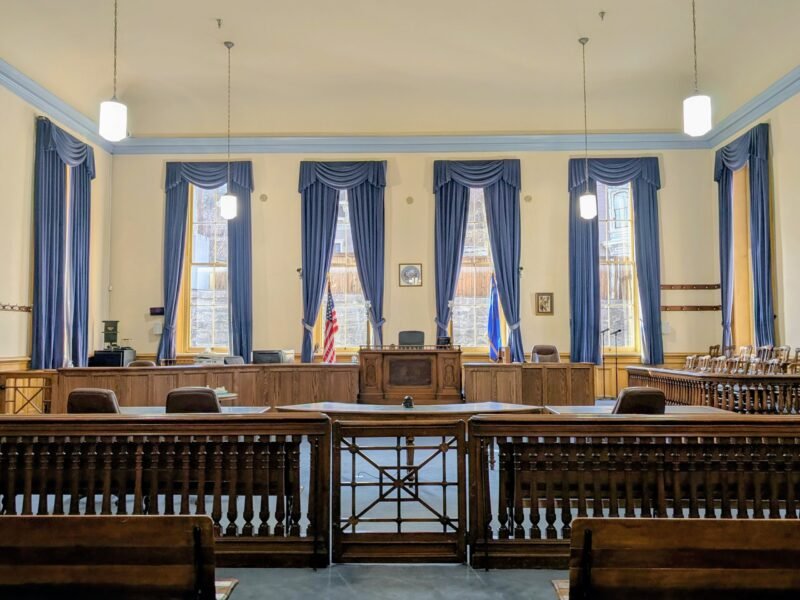
The city is built on a hill. So, in a narrow street raised above the main road is the State District Court. We stop to thank the deputy clerk who helps us cover the court and she opens the main courtroom so we can take a look.
We pass from the old mining town and its rich history to Carson City, the state capital. Dinner is at Red’s Old 395 Grill, where the rafters are filled with wagon wheels, mounted animal heads and a real stagecoach. The elements of a great dinner are friendly waiters, wood-fired salmon and chips, and a delicious Leave No Trace alpine lager from a brewery we’d just passed.
The Nevada court tour is over, and now it’s time to go home.
Restless, I wake up at three in the morning and decide to hit the road for a coffee drive, a seven-hour drive down US 395 on the quiet side of California’s great mountain range. The snow-covered landscapes of the Eastern Sierra are on the right, the empty, dry plains bordering Death Valley on the left, as I descend on a long run from northern Nevada to Southern California.
Subscribe to our free newsletters
Our weekly newsletter Closing arguments provides the latest on ongoing trials, major litigation and decisions in courts around the US and the world, while monthly Under the lights feeds legal dirt from Hollywood, sports, Big Tech and the arts.



