
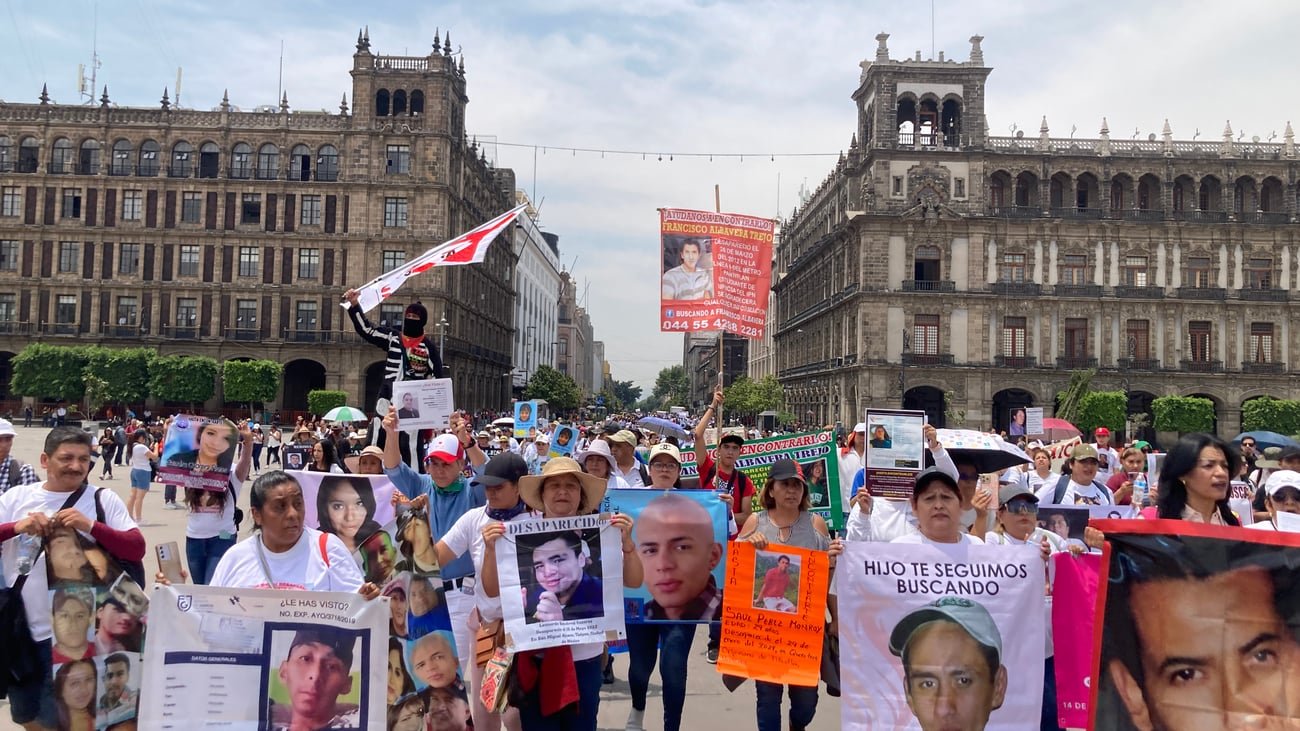

MEXICO CITY (CN) – In her press conference on Monday, Mexican President Claudia Sheinbaum said a United Nations resolution implicating the Mexican government in enforced disappearances focuses only on past events and administrations, without taking into account recent efforts.
Thursday DECISION by the UN Committee on Enforced Disappearances is the first in UN history
He determined that the Mexican government has been and continues to be sufficiently involved in the process of enforced disappearances in Mexico and is asking the UN Secretary-General to refer the situation to the UN General Assembly – a decision Sheinbaum flatly rejected.
“Some issues were not considered by the committee. That’s why the document was rejected,” Sheinbaum said, also arguing that the committee extrapolated data from just four Mexican states between 2009 and 2017, which she says have nothing to do with her administration and are mostly related to organized crime.
She also said that the definition of enforced disappearance at the hands of the state is defined by the United Nations as politically motivated, which she also disputes has happened during her administration. The Mexican government maintains that disappearances have only occurred in the past, particularly in the context of the war on drugs during the administration of President Felipe Calderón.
“This has nothing to do with the work we do with search teams, with the solidarity we have with parents, with relatives who unfortunately have a missing person; the vigilant work we are doing, the work we are doing to eradicate this terrible crime of disappearance in our country, mainly related to organized crime,” she said, echoing. STATEMENT Mexican officials released Thursday. “All this is not taken into account, so we reject the report.”
Unprecedented rejection
Alexia Martínez Montalban, a lawyer and international expert at the Miguel Agustín Pro Juárez Center for Human Rights, says the Mexican government’s protection is insufficient.
Noting that while the Mexican government’s response is a purely political maneuver and not illegal, she said it is inappropriate because the government ratified in 2007 the convention itself gives the committee the power to do what it is doing.
“Ratification means recognizing the capacity of the committee to monitor the implementation of the convention. The committee has several powers, among them is the power to carry out a country-to-country visit, which it did in 2021,” Martínez Montalban said.
She added that the commission has also received requests for urgent action from civil society organizations, one of the mechanisms that can be used to encourage the commission to urgently inform the state of a disappearance crisis and raise awareness of the case.
“Another mechanism is individual communication, utilizing the committee’s capacity, along with reports sent by the Mexican state itself and civil society organizations,” she added. “The committee has gathered information from Mexico from many sources and through many mechanisms. And over the years, the organizations had asked to activate article 34, which is the article that carries a higher level of severity or intensity, which should take the matter to the UN General Assembly.”
Article 34of the International Convention for the Protection of All Persons from Enforced Disappearance states that if the committee is provided with any information about systematic disappearance under the jurisdiction of a state party, it must be brought to the UN General Assembly through the UN Secretary-General.
In September 2025, the committee requested additional information regarding the situation of enforced disappearance, which the Mexican government provided but it was kept confidential at her request – an atypical procedure, according to Martínez Montalban. The information was made public last week.
“Let’s put it this way: the legal and institutional efforts of the state have not been enough,” she said, noting that the committee found that disappearances have continued since its visit in 2021. “The committee acknowledges this, and another finding worth sharing is that there is no policy at the federal level; it is not so much the ordering of disappearances, but the insufficiency of investigations and the cooperation of authorities that create the conditions for disappearances to continue in Mexico.”
The official statement of the Mexican government claims that the UN report does not take into account the recent reforms in this country General population lawAND General Law on Enforced Disappearances of Persons adopted in July 2025, which promote a series of legal reforms and institutional arrangements to address the crisis of disappearances.
“The committee has echoed many of their demands regarding the need to end the near-total impunity surrounding disappearances. The committee’s emergency action mechanisms have been very helpful for many families in encouraging the state to take action. So the fact that the Mexican state now ignores or rejects this position, this decision, is also a way of turning its back on the added victim.”
Because this is a procedure that has never been applied in history, it is unclear when the decision will be referred to the UN General Assembly.
“What we know is that it is now in the hands of the Secretary-General of the United Nations. We do not know if anything will happen before this time that the Secretary-General can do. The article of the convention itself says that it only thinks that the committee refers it to the Secretary-General,” Martínez Montalban said.
Findings and feedback
The committee cited the discovery of 4,500 clandestine graves containing over 6,200 bodies, 4,600 human remains and about 72,000 unidentified human remains since it began monitoring the situation in 2012.
The Committee found that there is direct state involvement in enforced disappearance on a fairly large scale that occurs in a systematic pattern of state acquiescence and structural impunity.
It also accepted the Mexican government’s position that enforced disappearances are primarily carried out by criminal organizations rather than the state, but found sufficient state involvement, or lack of prevention, to implicate the Mexican government in crimes against humanity under Article 5 of the International Convention for the Protection of All Persons from Enforced Disappearance.
“International law does not require that crimes against humanity occur nationwide or be orchestrated at the highest levels of government. What matters is the scale, the pattern of attacks and the targeting of civilians,” Juan Albán-Alencastro, committee chairman, told a UN. press release on Thursday announcing the report.
Seven non-governmental agencies fully supported the UN decision and responded to the Mexican government’s refusal in a joint statement on Thursday.
“Disqualification is not a state strategy. It is disturbing that the official response qualifies a technical report like the one presented today by the CED as one-sided and without rigor. The denigration of the messenger to avoid the message is a practice that Mexico, in its democratic aspiration, should not implement. Sovereignty is exercised respecting the provisions of the treaties which are not recommended by Mexico. voluntary part”, said the agencies.
The International Federation for Human Rights, together with Strategic Human Rights Issues, the Mexican Commission for the Protection and Promotion of Human Rights, and victims’ collectives, have documented widespread and systematic enforced disappearances in the country.
They argue in one STATEMENT that disappearances often occurred with the authorization, support or acquiescence of local public officials, and often in contexts of corruption for more than a decade.
On a Friday REPORTAmnesty International called on the Mexican government to release all information related to situations of enforced disappearance in the country, as required by Article 34.
According to the group, the disappearance crisis has left more than 133,000 people missing and more than 72,000 people unidentified.
Subscribe to our free newsletters
Our weekly newsletter Closing arguments provides the latest on ongoing trials, major litigation and decisions in courts around the US and the world, while monthly Under the lights feeds legal dirt from Hollywood, sports, Big Tech and the arts.



