
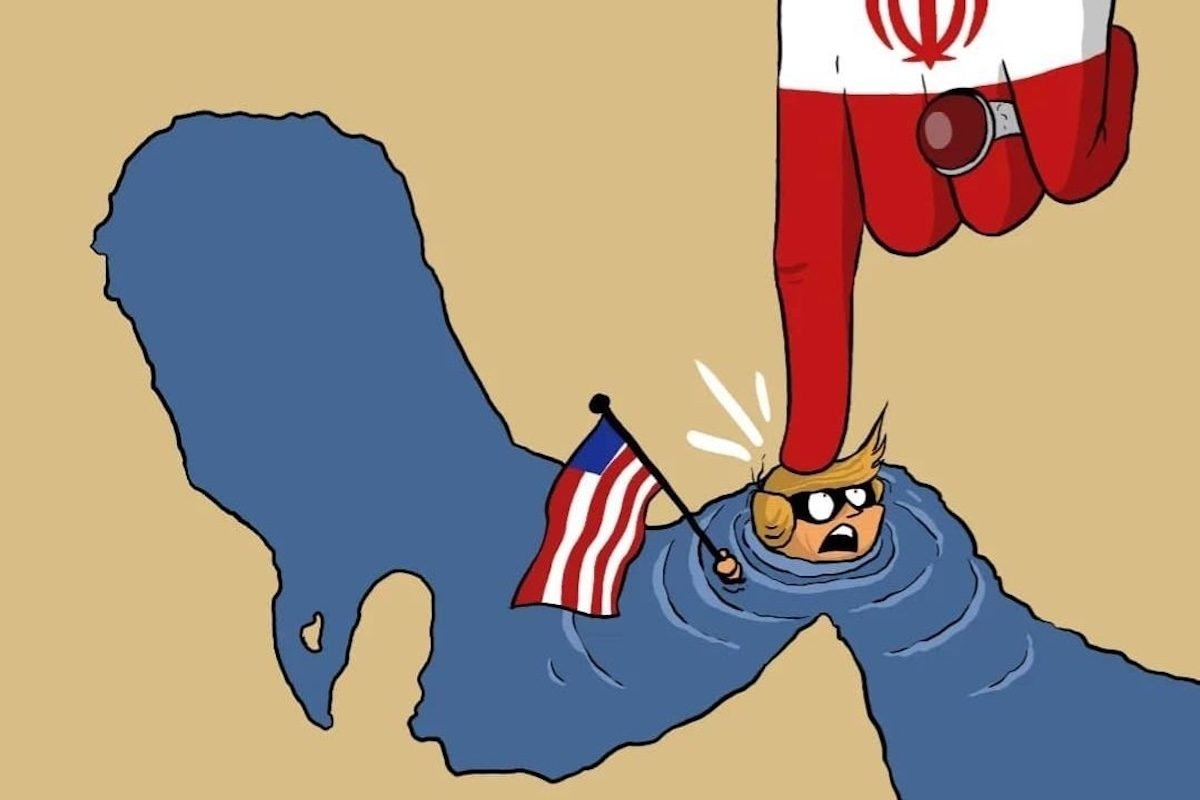

If China and Russia had a common slogan for their “strategic partnership,” it might be “MAWA – Make America Weak Again.” And if they had a dream, it would have been that Donald Trump would have been elected president in 2016 — and then re-elected in 2024 — and acted not on his Make America Great Again slogan, but on MAWA’s. So they must now be very happy that Trump is fighting Iran.
If he had managed to destroy the Iranian regime and increase American control over the world’s oil supplies, they might have felt uneasy. But there is no sign of this happening: quite the opposite.
If it continues, Trump’s devastating failure in Iran will make America weaker while strengthening China and Russia in important ways.
China benefits because Trump will now be an even weaker negotiating partner on trade than it was last fall when President Xi Jinping used the threat of an export embargo on critical minerals to force Trump to back down on his 145% tariffs on Chinese goods. If he goes to Beijing on May 14-15 for the rescheduled summit between the two leaders, he will go as a supplicant.
China also benefits diplomatically because other countries, rich and poor, see it as a more predictable and reliable superpower partner than the main alternative, the United States.
Russia benefits because the more than 50% increase in crude oil prices since the start of the war in Iran is saving the country’s public finances and enabling it to fight its war in Ukraine for longer. It could also benefit further if divisions over Iran between European governments and Trump lead to further reductions in US arms sales through Europe to Ukraine, and especially if in a moment of anger Trump decides to cut off all US intelligence and communications support to Ukraine.
Another longtime dream of President Vladimir Putin has been to destroy NATO, so if these transatlantic divisions over Iran encourage Trump to try to follow through on his frequent threat to pull America out of NATO, that would make him happy, too.
That happiness may not last long, as a withdrawal from NATO requires congressional approval, which would likely be resisted by a majority of Republicans in both the House and Senate. However, deepening transatlantic divisions would bring satisfaction to the Kremlin.
However, this sense that the loss of one superpower must inevitably be the gain of another superpower should not be taken too far. What an American failure in Iran would really do is make the three nuclear superpowers much more equal than previously appeared to be the case. They are all weak and they are all dangerous. This means that all of us in Europe and elsewhere must build our resilience to their actions.
Despite its nuclear arsenal and abundant resources, Russia has had four years of military failure in Ukraine, in which small territorial gains have been achieved at the cost of more than a million casualties, counting dead and wounded.
China, its partner, appears unable to exploit the situation because its economy is mired in slow annual growth, a shrinking and aging population and high public and private debt, trends that will not be eased by an energy price shock.
And America looks weak because it has re-elected a president who is openly corrupt, who embarked on a military adventure in the Middle East without a clear strategy, and who is doing daily damage to his country’s greatest global asset, its network of security alliances in Europe and Asia.
None of this bodes well for Europe, Japan or South Korea, which are key components of those security alliances. Everyone will be hurt if last month’s short-term energy shock turns long-term.
Thanks to that economic pressure, everyone will find it even harder to find the money to make their militaries strong enough to become less dependent on America, just at a time when that military spending is becoming more crucial to deterring attacks or intimidation from China and Russia.
I have spent the past week visiting Japan, asking Japanese business and government questions about the impact of the war in Iran. Three aspects of the responses were particularly relevant for Europe.
The first was somewhat reassuring: Although the way America has transferred military forces from Asia to fight Iran has led to some concern that this weaker American deterrence could tempt China to attempt an invasion or blockade of Taiwan, the main consensus in Japan is that this will not happen, thanks to China’s own weakness.
Failures in Ukraine and Iran by Russia and the United States will reinforce China’s wariness of risking its own military disaster, especially at a time when President Xi is continuing to crack down on corruption among top generals in the People’s Liberation Army.
The second, however, was more disturbing. It is the first time since atomic bombs were dropped on the Japanese cities of Hiroshima and Nagasaki 81 years ago that a public debate has begun on whether the country should consider acquiring its own nuclear weapons.
This may reflect nervousness over whether the Iran war might persuade more countries to go nuclear in order to protect themselves; it may reflect the uncertainty about the reliability of the US nuclear deterrent under which Japan, like Europe, is largely sheltered; may reflect uncertainty over whether the Trump administration’s desire that Japan and other allies do more to protect themselves might extend to nuclear weapons. In the past, US administrations have discouraged, and in the case of South Korea blocked, allies from going nuclear.
The fact that this discussion is happening at all reflects an acknowledgment that the world has become more dangerous and that the old rules and taboos can no longer be upheld.
The nuclear debate in Japan is currently more limited than the one taking place in Europe, led by France and Germany.
The third aspect was more in line with Europe, however: it is that Japanese business and officials are somewhat paralyzed by uncertainty about how long and how severe the energy price shock will be. They don’t want to spread panic, but they understand that they may need to adjust their energy plans for the next two decades or more, plans in which fossil fuels still played a leading role.
If long-term plans have to change, then the main options being considered are nuclear power, geothermal power and more wind and solar power. Thanks to resistance from big business, wind and solar account for a much smaller share – roughly 13%, mostly solar – of the electricity supply than in European countries, where wind and solar shares of 40-50% are common.
My Japanese friends, like us in Europe, are very conscious of their vulnerability. However, they are also aware that in a world in which technology is advancing so rapidly and in which sources of potential supply of energy and other critical commodities are widespread, the chance to reduce this vulnerability and to sidestep the impact of shocks exists, even if it takes time.
So the time to start planning how to protect ourselves and how to become more resilient to shocks like the one currently coming from the White House and from Iran is not tomorrow, it’s not in the 2030s. It’s now.
This article was first published in Italian translation by La Stampa. The English version is available at Bill Emmott’s Global View. Reprinted with permission.



