
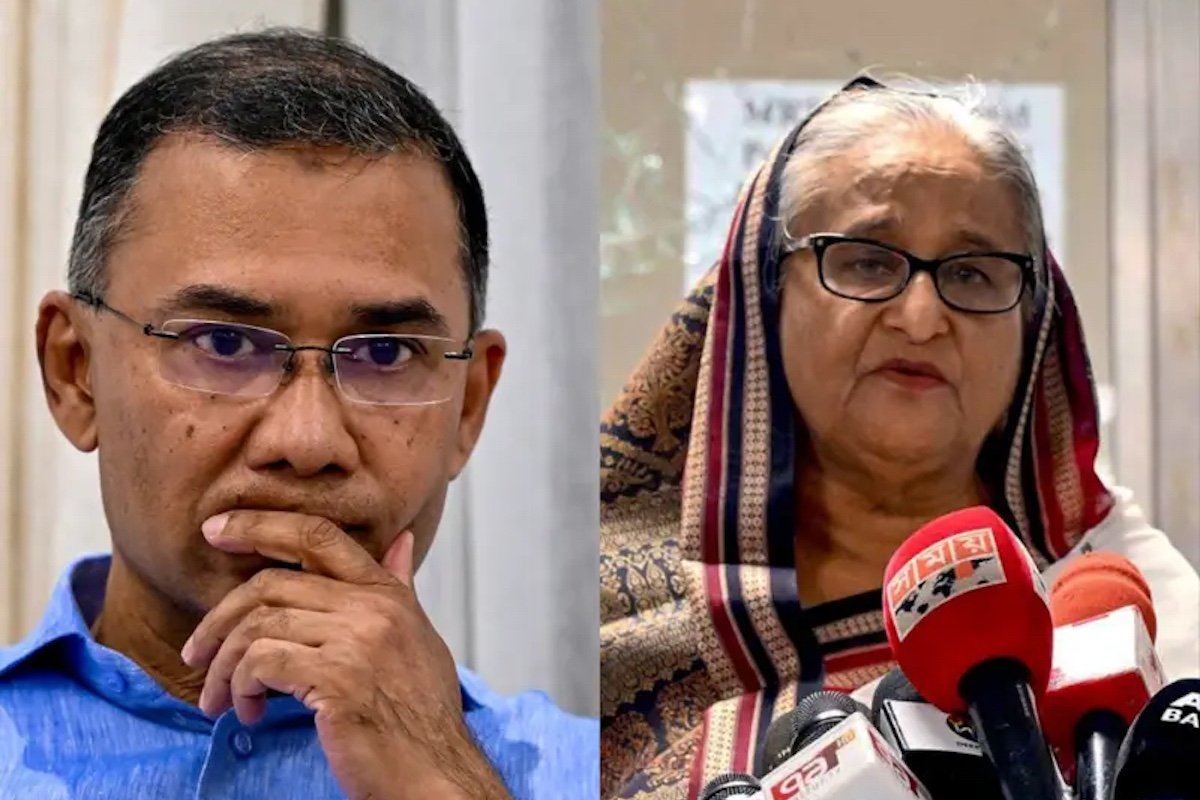

The letter landed within the already charged political atmosphere of Dhaka. Writing from abroad, the ousted Prime Minister Sheikh Hasina did the first official appeal at the Bangladesh International Criminal Court (ICT), seeking to overturn her death sentence on the grounds that she had been denied a fair trial.
For the newly elected government led by the Bangladesh Nationalist Party (BNP) – the main rival of Hasina’s Awami League – the letter is a reminder that even in exile in Delhi, Hasina still casts a defining shadow over Bangladesh’s difficult transition.
In the letter sent to ICT on March 30, Hasina not only challenged the verdict as legally untenable, but also asked the court to quash the sentence and stop any move towards execution, calling such steps incompatible with international legal obligations. Its absence apparently has not diminished its importance.
To understand why, one must go back to the mass uprising that forced him from power in August 2024.
Hasina’s fall from power followed a mass uprising that brought together opposition parties, civil society groups and a public disaffected after years of increasingly centralized rule – an episode she now reframes in her call for state accountability.
She argues that her government acted to maintain order and that any subsequent proceedings must meet “international standards of justice,” including proper notification of charges and the opportunity for a full legal defense.
The uprising itself marked one of the most violent chapters in Bangladesh’s recent political history. What began as widespread demonstrations over the government’s job quota quickly escalated into a deadly confrontation between protesters and state forces.
Rights groups and independent monitors have since estimated that around 1,400 people died during the 21-day uprising. Hasina’s government’s response at the time drew harsh condemnation both at home and abroad, forming the essential backdrop to a case that Hasina now seeks to recast largely as a failure of due process.
Subsequent investigations have further intensified scrutiny of Hasina’s role during those events. ICTY proceedings have cited what it describes as conclusive evidence that directives to use lethal force against protesters came from the highest levels of political authority.
Prosecutors argue that such findings support allegations of abuse of power and political violence, describing the court’s decision as rooted not only in the outcome of the uprising, but also in the decisions that shaped its trajectory.
Facing growing protests and a loss of institutional support, Hasina fled the country and took refuge in neighboring India. The subsequent legal process moved quickly. The ICT convicted her on charges related to political violence and abuse of authority, handing down a death sentence that her supporters call politically motivated and her opponents see as justice delayed.
Her new appeal shifts, at least for now, the argument from policy to process. Highlighting the lack of due process, she is appealing beyond Bangladesh’s borders, where concerns about the death penalty and judicial standards carry weight. However, for Bangladesh’s new government, as well as opposition parties, the issue is less legal than political.
Prime Minister Tarique Rahman’s new government has shown no indication of lifting the ban on the Awami League imposed by the previous interim administration of Muhammad Yunus.
Also, the BNP came to power with the support of groups that define themselves as opposed to Hasina’s rule. For them, her departure was a corrective moment for the nation. Any softening would now be seen as a retreat.
The organizational capacity of the Awami League has definitely weakened, its leadership has been dispersed and its public activity has been limited. However, she maintains a solid base of support, especially among voters who associate her mandate with economic benefits and infrastructure expansion. This residual force makes it too important to ignore, but too contentious to quickly re-legitimize.
The result is a political equilibrium that is stable but incomplete. Excluding the Awami League simplifies short-term governance but complicates long-term consolidation. The history of Bangladesh provides several examples of dominant parties returning after periods of repression. The current agreement does not eliminate this possibility, on the contrary, it postpones it.
Hasina’s own stance reinforces the impasse. Her public statements, including the latest appeal, focus narrowly on the fairness of the trial. There has been no acknowledgment of the grievances that fueled the uprising or allegations of harsh governance during her tenure. This is a deliberate choice.
A guilty plea would weaken her claim that the case against her is politically motivated. But the absence of any conciliatory signal reduces the scope for its eventual political rehabilitation.
For the government, this is convenient in the short term. A defiant Hasina is easier to rule out than a repentant one. But it also deepens polarization. Without some form of narrative adjustment – whether by Hasina or her opponents – the political system risks becoming entrenched in a long-entrenched winner-takes-all structure with limited room for reintegration.
External factors add to the complexity. India, Hasina’s longtime ally, has little incentive to ease her return to current conditions. Extraditing a former prime minister to face execution would be politically and diplomatically costly.
At the same time, India has signaled that its broader relationship with Bangladesh will not depend on its fate. This reduces Dhaka’s influence by allowing both sides to share the issue.
For Tarique Rahman, reckoning is limited on multiple fronts. Domestically, he must satisfy a coalition that expects accountability and exclusion. Internationally, he faces pressure to demonstrate respect for legal norms and political pluralism. The Hasina case lies at the intersection of these demands.
Her letter to the court highlights this tension. Bangladesh’s transition has removed a dominant leader without resolving the issue of her political constituency. As long as that zone exists and as long as Hasina continues to contest the legitimacy of the process against her, it remains a factor in the system.
In this sense, its role has changed rather than disappeared. She is no longer the central actress, but she is still a strong point of reference. The new government can continue without it, but not beyond it.
Faisal Mahmud is a journalist and analyst based in Dhaka



