

Silicon Valley futurist Roy Amara famously observed in the 1970s that we “tend to overestimate the effect of a technology in the short term and underestimate the effect in the long term.”
This insight – later dubbed “Amara’s Law” – has since traveled far beyond the realm of technology, providing a useful paradigm through which to understand disruption in all its forms.
Consider America’s attack on Iran. Its immediate costs are easily quantifiable: disruptions to oil, petrochemical and fertilizer supply chains; rising global prices; and, most notably, the loss of human life. These are the obvious, short-term consequences.
Long-term effects are much less measurable and certain. One conclusion seems inescapable: the Iranian regime will endure. In the process, however, its relations with its Arab neighbors could be strained for generations.
Also, instead of being weakened, Tehran may become more self-confident; his sense of strategic confidence is reinforced. Meanwhile, a new generation of Iranian youth may emerge with a lasting anti-Western sentiment.
Yes, the oil will flow again. Markets will stabilize; supply chains will adapt. But, as with the world’s first atomic explosion, the rift in the Strait of Hormuz reveals two enduring truths.
First, it shows that such disruption is an effective political weapon. Second, like splitting the atom, that knowledge cannot be unlearned.
The result is a region at risk of settling into a prolonged and uncertain stasis—defined by unresolved tensions, strategic mistrust, and latent instability. The strait itself stands, indifferent and unmoved, governed not by politics but by much older geotechnical forces.
This is a problem for the parties to the conflict. But what about the others? For example, the energy-hungry but resource-constrained economies of Asia. Are they prepared for a future in which this vital artery can narrow so suddenly?
Hardly. Are they willing to be drawn into future conflicts to ensure supply? Some might, but most regard such mercantilism as a relic of another era—too expensive, strategically fraught, and morally dubious.
So-called strategic oil reserves, such as those held by the United States, are expensive to maintain. At best, they can stabilize markets for a short time, buying time for a bid response. However, their primary purpose is to support military readiness, not to ensure long-term security.
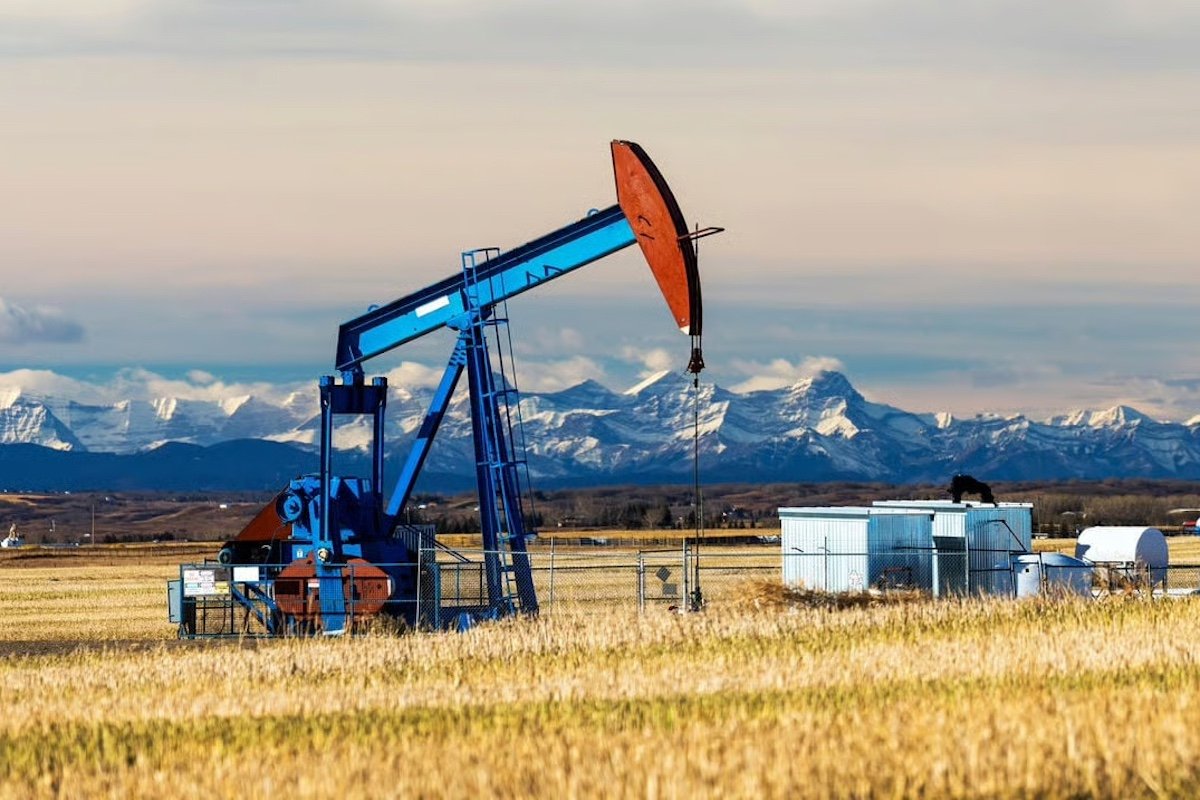
There is, fortunately, another option for Asia’s energy-hungry markets. The interior Canadian province of Alberta holds third largest oil reserves in the world, after Saudi Arabia and Venezuela. Current production is approx four million barrels per day– enough, in principle, to satisfy everyone of Japan’s oil demand for example.
The province is also a major producer of natural gas. Equally important, it has a powerful supply of free electricity needed to power the condensers needed for liquefaction and transport. However, this is only part of the story.
Alberta’s manufacturing remains constrained by a chronic lack of infrastructure investment. The output can be significantly higher. The main challenge is market access: nearly 90% of Alberta’s oil exports flow to the United States– mainly at Midwest refineries in Illinois, Minnesota and Wisconsin.
With few alternative outlets, Canada effectively sells into a monopsony, thereby accepting a continuous discount to the market, usually starting from 17% to 37%.
Canadians have tolerated this arrangement for two reasons. First, successive federal governments have restricted resource development in the name of climate policy. This is prompted by US-funded environmental groups who have tainted the industry.
Second, there has long been a belief in a stable, mutually beneficial relationship with the US. Cheap oil for goodwill in consideration of good name in other areas, especially in Ontario’s automotive sector, for example.
The election of Mark Carney – former governor of the Bank of Canada and the Bank of England, plus past deputy chairman of Brookfield Asset Management – has begun to change this balance. Rhetoric remains cautiousbut politics is becoming more pragmatic.
Meanwhile, Canada’s economy is under increasing pressure from a historic trading partner that is, at best, unpredictable and ruthlessly self-interested. Others would claim it is predatory.
Many Canadians feel disrespected and trade diversification has re-emerged as a serious policy objective. This ambition has been expressed for decades; this time it has more weight.
At the same time, public finances are tightening and energy development offers a clear path to economic growth and fiscal stability. The alternatives are less obvious. Carney seems to understand these realities.
Western Canada presents a compelling alternative to Asia: a stable and abundant source of energy, supported by well-managed ports, mature legal and financial institutions and a predictable political environment. More importantly, it provides a direct route to Pacific markets, largely insulated from regional conflicts.
The challenge remains access to tidal waters. Canada has only one major pipeline on the Pacific coast: the Trans Mountain Pipeline. After its expansion in 2024, it can carry just under a million barrels per dayout of about 350,000.
This project cost $30 billion and went ahead only after the federal government stepped in to buy it from US-based Kinder Morgan. Plans to add another 200,000 barrels per day of capacity are now being considered.
What both Canada and Asia need is a significant expansion of capacity on Canada’s West Coast. Circumstances are matching. Foreign direct investment in pipelines and upstream development can ensure a reliable energy supply for decades to come.
Equally important, this supply is likely to remain available at a discount to global spot prices—perhaps a narrower one, but a discount nonetheless.
Most Canadian oil will still flow to the US. But Canada would benefit from higher overall production, higher royalties and a gradual narrowing of the discount on southbound exports.
The missiles now passing over the Persian Gulf will eventually fall silent. The Strait of Hormuz will once again be filled with tankers. Yet, as Amara’s perspective suggests, the deeper ramifications of this moment will only become clear long after the immediate disruption has passed—and, perhaps, been forgotten.
What is clearer is that the conditions for a dramatic change in the energy supply chain have never been better.
Charlie Grahn is a supply chain veteran and business instructor at Langara College in Vancouver, Canada.



