

By Mary Yang
Chinese authorities have banned the burial of cremated remains in empty apartments, a practice that had gained popularity as mourners took advantage of the depressed housing market to avoid rising funeral costs.

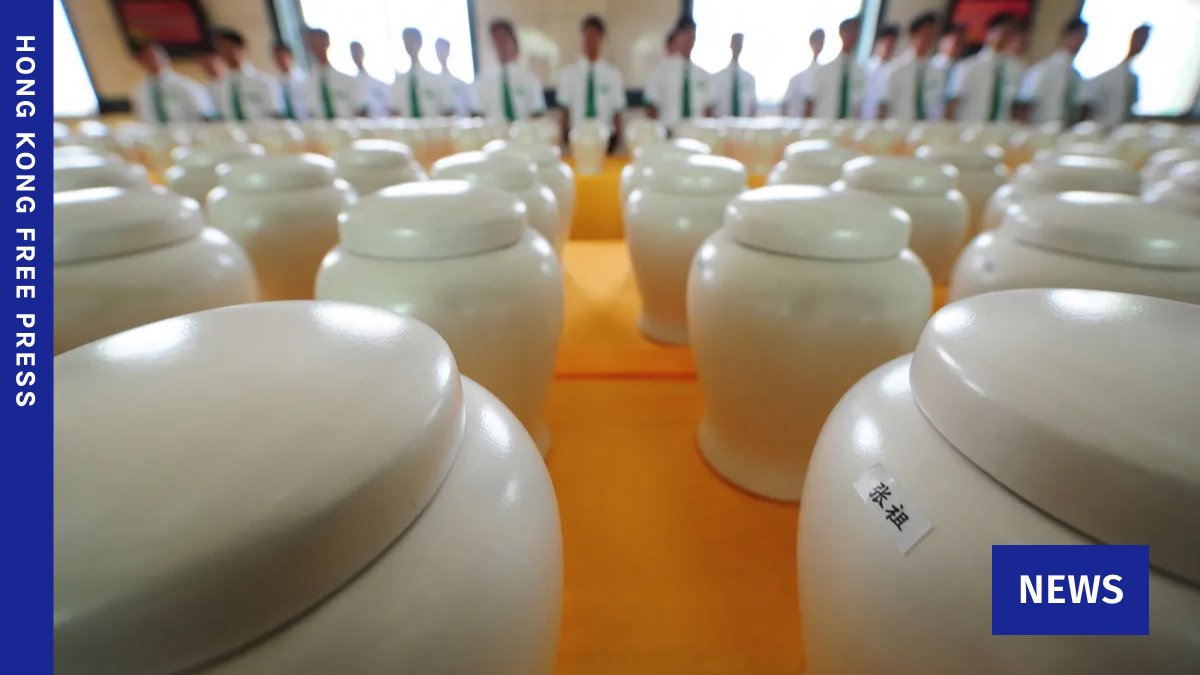
“Bone Ash Apartments” are units in often occupied residential complexes used by some families as resting places for the remains of their loved ones.
They could be cheaper than a public cemetery plot, according to local media, and give families more control over the site.
Getting one “kills two birds with one stone,” Carsten Herrmann-Pillath of Germany’s Erfurt University told AFP.
“It is an investment and facilitates (the process of performing) ritual practices.”
But the regulations that went into effect Monday explicitly prohibit “the use of residential properties specifically for the burial of ashes.”
According to Chinese media reports, apartments with bone ashes are often identifiable by closed windows or closed curtains.
A resident quoted by the Communist Party-run Legal Daily newspaper described looking inside an apartment on his property to see two candlesticks around a black box and a black-and-white portrait, a typical arrangement in China for commemorating the dead.
The ban comes days before the Qingming Festival, also known as Grave Cleaning Day, when families traditionally visit the graves of relatives to tidy them up and make ritual offerings.
It appears to be aimed at stopping developers and brokers from selling empty units “implicitly allowing their use for grace,” said Xinyi Wu, a doctoral student in anthropology at the University of California, Irvine, whose research has focused on the phenomenon.
Blurred lines
Human remains are only allowed to be buried in designated areas such as public cemeteries, according to the State Council, China’s cabinet.

Demand for cemetery plots is growing, however, as China’s population ages and deaths outnumber births.
In 2020, funerals cost almost half of the country’s average annual salary, according to a survey by British insurance firm SunLife.
On Tuesday, China’s market watchdog announced new rules to tackle fraud and a lack of transparency in funeral prices to “reduce the burden of funerals on the masses”.
Meanwhile, apartment prices have continued to fall as consumer confidence remains low and a long-running property sector crisis continues.
Debt and stalled construction have plagued major firms since 2020, when curbs on excessive borrowing and speculation dramatically narrowed access to credit.
The practice of using dwellings as burial sites is “problematic” for Chinese officials, UC Irvine’s Wu said, as “it blurs the line between spaces for the living and spaces for the dead, which is administratively and culturally sensitive.”
Many people on social media had expressed concerns about living near the dead, as well as the resale value of their homes, she added.
Some online comments took a more humorous view.
“I want to rent a place with these kinds of bone ashes up and down and left and right,” read one. “There won’t be any problems with the neighbors.”





