
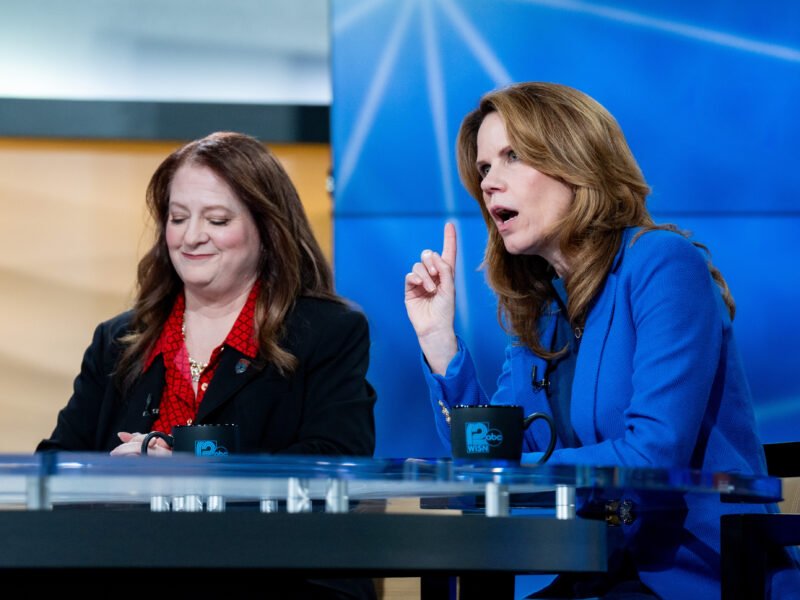

MILWAUKEE (CN) – Two state appeals judges faced off Thursday night in a debate that touched on hot-button issues from abortion rights to President Donald Trump’s attack on the judiciary, underscoring the politicization of the court.
The argument between appellate judges Maria Lazar and Chris Taylor was delayed twice — once after Taylor was unexpectedly hospitalized with kidney stones and again for a tornado watch in the greater Milwaukee area.
The pair began with a handshake and maintained a level of decorum not often seen in Wisconsin politics, though it was far from friendly. While the April 7 state Supreme Court election is officially nonpartisan, the justices traded tense jabs on all the same issues that will be seen between lawmakers on opposite sides of the aisle.
Lazar, 61, describes her approach as “originalism with a dash of textualism” and has spent much of her campaign opposing “activist judges.”
The seven-year District II judge hails from Brookfield, Wisconsin, and advocates restraint on the bench — a trait she says voters need and her opponent lacks.
Taylor, 58, is a former member of the Wisconsin Assembly and policy planner for Planned Parenthood. After that, she served on the Dane County Circuit Court and is now on the 4th Circuit Court of Appeals.
Although she denies being a registered Democrat, the Californian has centered her campaign around many of the party’s biggest winning issues, such as abortion and criticism of the Trump administration.
Lazar took every opportunity during Thursday night’s debate to point to Taylor’s roots as a lawmaker, arguing that she would put her causes above the law if elected. Lazar has 12 years of experience on Taylor’s six-point bench.
“ You have an extreme radical legislator who is known as the most liberal of the 99 in the assembly, who now as a judicial activist wants to impose her views, values and agenda in court on the law,” said Lazar.
The candidates’ differences appeared most stark on questions about abortion policy in Wisconsin, where the high court struck down a total abortion ban dating back to 1849 just last summer.
While Lazar responded to questions about that case from last summer by saying she didn’t follow the reports or hearings, Taylor took the opportunity to say she would have voted with the majority.
“It’s tragic that we have someone running for the state Supreme Court who is celebrating that there are women all over this country who are victims of rape and incest,” Taylor said, dismissing Lazar’s protests. “This is the reality of overturning Roe v. Wade, which you called ‘very wise.'”
Lazarus, looking horrified by the implication, tried to cut Taylor several times.
“This is absolutely ridiculous,” Lazar said. “That’s exactly what we’ve done in this campaign. It’s the same old political playbook. I’ve never wanted women hurt, never, never, never. To say I want women to die or suffer is absurd.”
The role of the judiciary
One theme the candidates may agree on in Thursday’s debate is Trump’s effort to exert influence over the judiciary. Asked about the arrest and prosecution of Judge Hannah Dugan — who was convicted in December of obstructing immigration enforcement — they agreed things have gone too far.
“There have been threats to judges and rhetoric that I don’t like — I think the way Judge Dugan was arrested created a spectacle and it shouldn’t have happened that way,” Taylor said. “That was disturbing.”
For the first time all night, Lazar nodded in agreement as Taylor condemned the Trump administration’s campaign against judges and vowed to support an independent judiciary in the face of federal overreach.
“The life of a judge is hard, and it doesn’t help when you have politicians insulting judges,” Lazar said. “Judges are under significant threats, and I have spoken about this before our state legislature in an effort to complete the judicial security package.”
Seemingly non-partisan
Tuesday’s winner will replace Judge Rebecca Bradley, a strong conservative voice on the bench known for her exhaustive questions during oral arguments and outspoken critical dissenting opinions.
In announcing her retirement, Bradley referred to a perceived epidemic of judicial activism among her liberal colleagues. Her outspoken dissenting opinions often ring alarm bells on the subject, once even accusing Chief Justice Jill Karofsky of cheating on women as a whole in a recent case involving abortion.
The moderators at one point pitted the candidates against Bradley, asking if they agreed with him about the state of the court and what they would do if elected.
Taylor recalled her time as part of the minority in the legislature when unconstitutional laws were passed and later upheld by a conservative state Supreme Court “in the pocket of right-wing extremists.”
The approach is likely to resonate with politically engaged voters, who may be thinking about the court’s makeup in the coming years. A Lazar victory could give conservatives an opportunity to return the court’s ideological majority as early as 2028.
But Taylor’s victory could create a liberal majority by 2030. With the last two state Supreme Court elections ending in landslide victories for liberal candidates, state Republicans are in no rush to endorse Lazar.
The Republican Party of Wisconsin expected to make a significant contribution to Lazar’s campaign by mid-March, while the Democratic Party of Wisconsin has given nearly $1 million to Taylor’s campaign since she entered the race.
survey shows that most voters were still undecided at the end of March. Among likely voters, Taylor maintains her lead just five days away from the April 7 election.
Lazar said Thursday that her standing as an independent was the reason, but experts told Courthouse News that the state party is still licking her wounds from the upset in 2025, when Judge Susan Crawford defeated the conservative candidate by ten points, despite an endorsement from President Donald Trump and millions in funding from Elon Musk.

Subscribe to our free newsletters
Our weekly newsletter Closing arguments provides the latest on ongoing trials, major litigation and decisions in courts around the US and the world, while monthly Under the lights feeds legal dirt from Hollywood, sports, Big Tech and the arts.



