
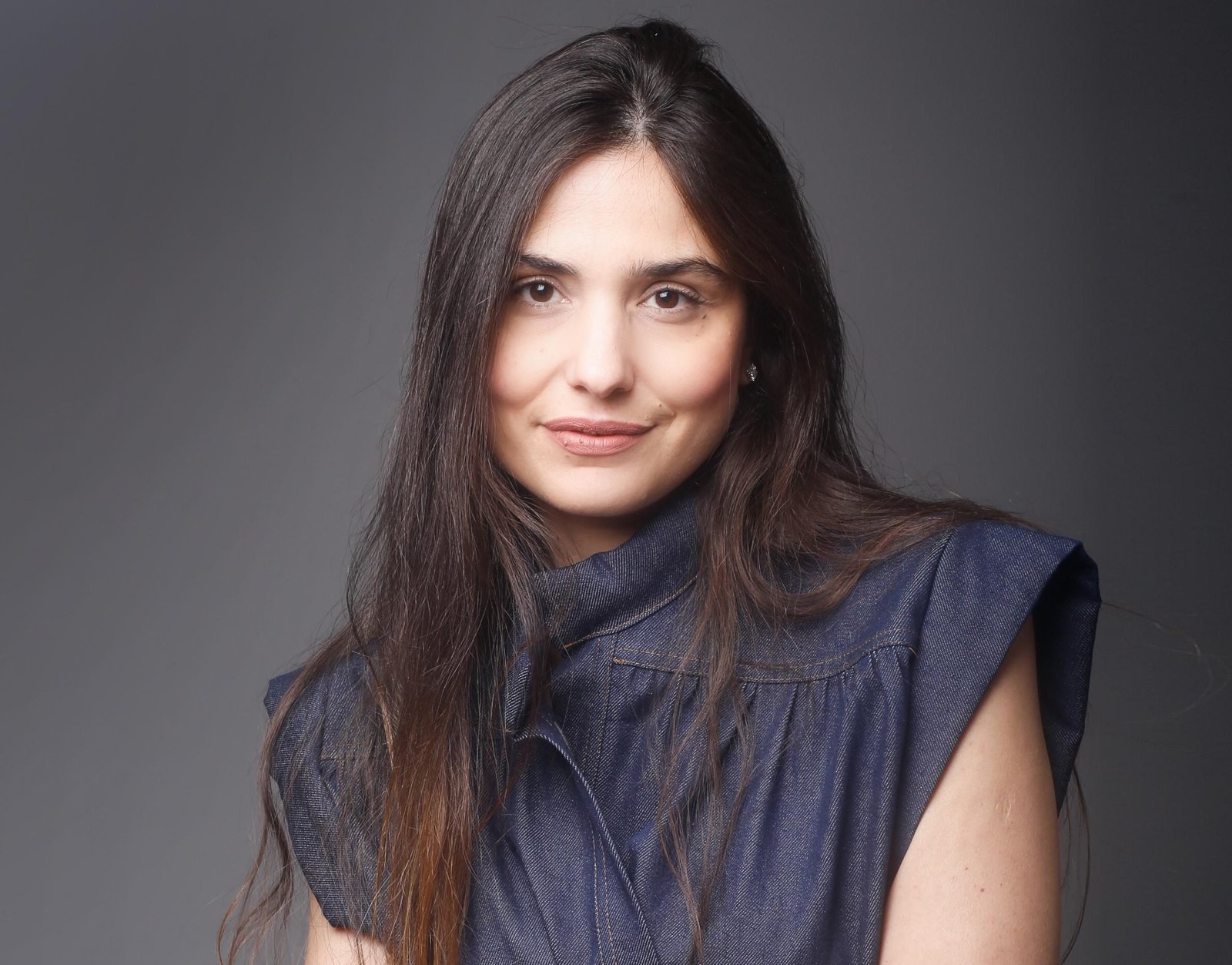


“When it comes to art, I’ve always followed my intuition.” Yasmine Berrada the Observer shows. We are at Loft Gallery in Casablanca, surrounded by abstract, geometric and seaweed-like works of Malika Agueznaya pioneer artist of the famous Casablanca school. “I feel that the art world is deeply emotional, so you have to put your whole heart into it.” And Berrada certainly does. When we meet her, she cuts an understated and elegant figure, dressed all in white, having just returned from an intense week in Doha for Art Basel Qatarwhere she displayed her iridescent work Mustapha Azeroual in the gallery booth.
In Casablanca, it’s like the calm after the storm, and the gallerist feels a little giddy as we walk through a room of works by Moroccan artist Malika Agueznay, reminiscent in its immersive quality of a Yayoi Kusama installation. We sit in the back of the gallery and Berrada orders some mint tea. She founded Loft Gallery in 2009 with her sister Myriem, based on the idea of a New York-style art-filled loft. From day one, the gallery represented something new in Morocco; It has since expanded with a three-story space in Marrakech.
According to Berrada, the market for Moroccan art was much more subdued at the time. “There were a lot of art dealers, but very few galleries doing structured, long-term work. It was a very local market. Moroccans only bought Moroccan art and weren’t interested in international work. And foreigners didn’t collect a lot of Moroccan art. There was also a lot of mimicry; people always collected the same artists.”
Loft’s main objective was to recover the history of Moroccan modernism, particularly the Casablanca School and the post-protectorate abstract movement. Working with artists such as Melehi and Belkahia, Berrada supported exhibitions and published publications. Over time, the gallery focused more and more on contemporary artists and began to connect them with international collectors.

“You have to trust the artists,” says Berrada. “Often, you start with an emerging artist and you don’t sell anything for the first two years. People wonder why you persisted, and then suddenly, after two or three years, the work starts selling really well. You have to have conviction. If we don’t put that energy into the artists, nobody else will.”
Through Loft, Berrada has cultivated a clientele who don’t limit themselves to buying random pieces of Moroccan art, preferring to think strategically about the legacy of artists and movements. Some are lending it to biennials, supporting museum initiatives or creating foundations.
The gallery’s participation in international fairs such as Art Basel Paris, Art Basel Doha, Art Dubai and 1-54 Contemporary African Art Fair has helped position Moroccan artists on the global stage. at the same time, Marrakech has grown to become a cultural center connecting Europe, the Middle East and Africa. “The countries of the Global South are waking up,” Berrada asserts. “There is institutional energy, there is investment. The public I used to meet in London and New York, I now meet in the Persian Gulf.”
While the future of the Gulf art ecosystem is currently uncertain, just a month ago, Berrada made a big bet for Art Basel Qatar—Loft was the only gallery from Morocco at the fair. The weight of the single representation of the Moroccan art scene was real and did not stop at the most anticipated event of the beginning of 2026. As one of the most important contemporary art spaces in Moroccoshe felt compelled to multiply her presence during Marrakech Art Week, which coincided with the 1-54 African Art Fair, organizing a “Loft Art GalleryTaking Marrakech Citywide” during the 1-54 African Contemporary Art Fair, presenting an expanded program of exhibitions, site-specific installations and citywide interventions throughout Marrakech, from riads to museums, public spaces and the Marrakech Loft.

Berrada is, like most dealers, also a collector and intuitive. Gathering has always been a deeply personal activity for him: a record of interactions, friendships and discoveries. From modernists like Melehi and Belkahia to contemporary artists like Lamrabat, Choumali and Kilito, the works in her home tell a story not only of her personal preferences, but also of the ongoing history of Moroccan and African art.
Yasmine’s collecting journey began in childhood. “All my life, I had watched my father collect art. I couldn’t understand why he was buying so many paintings,” she explains. “I’ve always felt that he just kept buying and buying as if to satisfy some kind of unconscious need. I think I’m a lot like him in that way.” However, their tastes and areas of interest differ. “He gathered many orientalist painters like Hassan El Glaouiwhile I am much closer to a contemporary point of view. But we are both driven by passion. We collect what we like and find it very difficult to sell the work. The main task for us has never been the idea of resale or investment.”
It was this approach that led, as a young property manager, to her acquiring her first artwork. She only became a full-time gallerist after the birth of her first son: “I bought a piece of art from a local artist,” she says. “And from there I just kept collecting naturally and organically.” Today, Berrada’s home is animated by pieces from her collection, which spans generations and media. Alongside the masters of the Casablanca school, she surrounds herself with contemporary voices such as Joanna ChoumaliM’hammed Kilito, Nassim Azarzar, Snoussi himself AND Bouchra Boudoua. “For me, these works of art are like family jewels,” she says. “But these works are also part of our daily life.” They eat regularly, for example, at a table made of Mohamed Melehi.
The family often exchanges works of art instead of more practical gifts. “I recently received from my husband a wonderful ceramic piece by the Moroccan modernist Farid Belkahia“, says Berrada, “I started a tradition with my children, giving them works Fares Thabet, Amina RezkiMelehi and Mous Lamrabat. It’s a way to enhance a sensibility and convey a set of values and appreciation for beauty and culture.” One work she particularly likes is a profile of a “blue man” by Lamrabat, who creates pictures of a fictional pan-African reality suspended between Arab and African futurism and the movie Avatar.

From a wavy and colorful abstraction by Melehi to the primitive forms of Belkahia, every object in her home is connected to a memory or a story, be it a studio visit, a first meeting or a conversation with an artist or friend. She can often be found visiting artists’ studios and often walks away with at least one job – sometimes paying more than she would pay later if she decided to represent the artist professionally. “It doesn’t matter,” she says. “For me, the collection is an integral part of showing confidence in the artist and a genuine interest, as well as building relationships.”
Only in recent years has Berrada begun to reflect on her collection as a whole; its aim is to structure, catalog and archive it while preserving the personal resonance that makes it meaningful. “Lately, I’m finding that I can identify certain themes,” she reveals. “And I’m starting to buy pieces that I think are missing—figurative paintings, for example—to balance out the amount of abstract pieces.” The figurative painting she shows depicts a black woman dancing in a red dress on a city corniche, which does not directly face the viewer. The mysterious image is joyful and scary at the same time, conveying a sense of nostalgia, like a kind of “saudade”.
Her dual roles – gallerist and collector – inevitably overlap, but this creates a healthy tension between spontaneity and structure. “For the gallery, I do very structured work, where there is strategy, research and long-term vision. For my collection, it’s much more spontaneous; I buy if I fall in love with a piece.” Of course, there are times when her approach to each matches. “I believe in meetings. When I meet an artist, I take my time to understand them, listen and see what story I can tell with it all. I love telling stories. And little by little, the stories come together and create a larger collective. One that can live beyond us.”

More art collector interviews



