
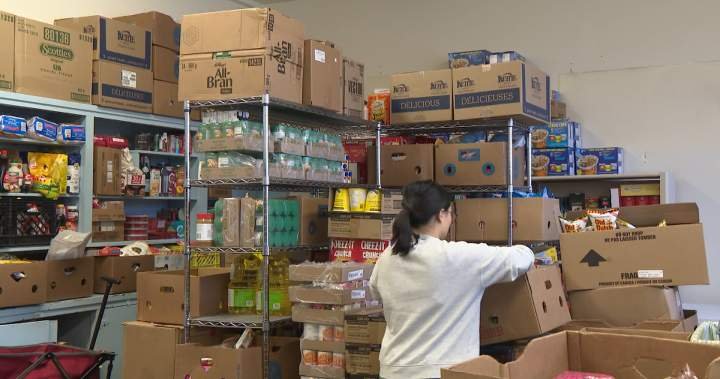

From reducing the number of visits to the amount of food provided, food banks across Canada are changing the way they operate as demand has become “unprecedented.”

Earlier this month, the food bank in Moose Jaw, Sask., said visitors had increased 150 percent compared to four years ago, prompting the nonprofit to decide to distribute goods once a month instead of its current bi-monthly pickup program.
But service changes are happening from coast to coast to coast, with Food Banks Alberta saying it hasn’t slowed down.
“What we’re really seeing across the country and certainly across the province of Alberta has been just an unprecedented increase in demand and need for food support and services from food banks,” said Melissa From, a Food Banks Alberta board member.
From, who is also president and CEO of the Calgary Food Bank, said it really started with the “tipping point” of the COVID-19 pandemic when issues of employment and income insecurity hit. After that, inflation across Canada raised the costs of things like mortgages, fuel and food, which fueled more demand for food.
According to Food Banks Alberta, 132,402 people received food from a food bank in the province this month, with 36 per cent of users being children.
From this growing demand has come changes, especially for smaller communities, as they have less money and donations.

Get weekly health news
Get the latest medical news and health information delivered to you every Sunday.
“We have some food banks that have to make the decision to give less food to more people,” she said. “We have some people who have to figure out how to classify the clients who are coming to them and who need the most support, and so no two food banks are facing the same situation, albeit many of the same challenges.”
The story is the same in Ontario, with food banks across the province reporting economic uncertainty making for another “challenging year” for many.

Feed Ontario reports that in 2025, food banks in the province served more than one million people who accessed its services more than 8.7 million times.
The nonprofit added in its network’s 2025 survey, only 33 percent of food banks said at the time they were able to meet the demand. Others had to adapt.
“So if they have to adapt their services, reduce from weekly to bi-monthly visits, instead of providing seven days’ worth of food, providing five days’ worth of food for wrapping support,” said Carolyn Stewart, CEO of Feed Ontario.
Stewart said some food bank workers have also reported buying food for their programs because they too have faced a drop in donations as previous donors have also faced financial hardships of their own.
Despite the growing need, Stewart told Global News that even with food banks stretched thin, people should not be discouraged from visiting.
“If you need and need food, please come in the door,” she said.
Food Banks Canada notes that food insecurity is spreading from big cities like Vancouver and Toronto to small communities like Moose Jaw or Truro, NS
Kirstin Beardsley, CEO of Food Banks Canada, said issues like the cost of housing are driving people to the service.
“This is not a problem for one part of the country or one type of community,” Beardsley said.
Food Banks Canada’s latest Hunger Count report found that 52 per cent of food banks in its network needed to provide less food than usual in 2025 and 23 per cent ran out of food before demand was met.
Beardsley said that’s why governments at all levels must continue to address food security and make investments and policies that can help with issues like affordable housing and food prices that are creating this struggle.
However, she added that a broad-based policy or change will not fix it for the entire country.
“The thing about food insecurity is that there’s no silver bullet or one-size-fits-all,” Beardsley said.
© 2026 Global News, a division of Corus Entertainment Inc.



