

Has Pakistan really become important on the global stage, or is it being strategically projected as such?
A closer look suggests that much of the current visibility around Pakistan has less to do with increasing its global influence or capabilities and more with a situational, strategic boost – largely driven by Western interests in the midst of ongoing Middle East conflict.
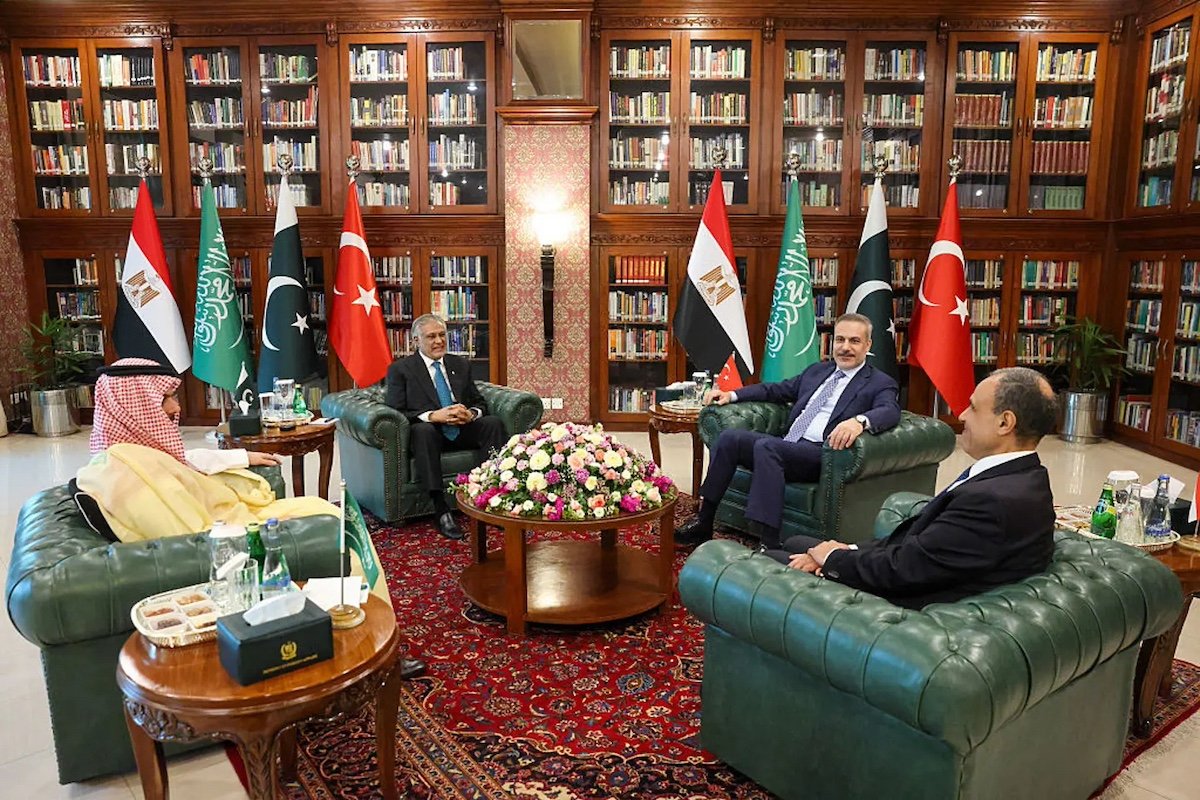
Pakistan is being portrayed as a potential mediator in the conflict involving Iran, the United States and Israel. A final meeting was held in Islamabad, but the actual parties to the conflict – Iran, the United States and Israel – were not present.
Instead, the meeting included regional actors such as Turkey, Saudi Arabia and Egypt, serving a preparatory role aimed at exploring the possibility of future engagement rather than facilitating direct negotiations. This projection must be understood in a broader strategic context.
The war, initially expected by the US to be short and decisive, has instead proved far more complex and protracted as it enters its second month. The assumption that limited bombing would quickly stabilize the situation has been proven wrong.
Iran’s response has been sudden and significant – targeting not only military installations but also commercial and energy interests, raising the costs of the war and escalating the conflict both horizontally and vertically.
The strategic implications are profound. With the Strait of Hormuz effectively blocked and global oil supplies cut off, energy prices have soared. Nations around the world are feeling the impact, and the global economy is accelerating toward a potentially catastrophic recession.
The possibility of further escalation – including disruptions in Bab el-Mandeb – adds to the weight of the situation, as the Houthis, Iran’s proxies in Yemen, also entered the conflict this past weekend by bombing Israel.
In such a scenario, the US and its allies seem increasingly keen to find a way out, wary of being drawn into another protracted war in the region. The US has a history of getting bogged down in such conflicts, popularly known as America’s “permanent wars,” draining its resources and limiting its ability to focus on other strategic theaters, including the Indo-Pacific.
Many Gulf countries cannot play this mediating role. Countries such as Qatar, Oman and Bahrain are actually parties to the conflict – Iran has carried out missile and drone strikes targeting their territory, including military bases and critical energy infrastructure. This makes them active rather than neutral actors.
It is within this context that Pakistan is behaving and projecting itself as a mediator. The question is: why Pakistan? The answer lies not in increasing Pakistan’s independent global status, but in a combination of strategic convenience and Pakistan’s own obligations.
First, Pakistan recently entered into a mutual defense pact with Saudi Arabia that contains a NATO-like clause under which an attack on one is considered an attack on both.
If this war is prolonged, Pakistan may be drawn into the conflict on Riyadh’s side. This creates urgency for Pakistan to prevent escalation so as not to join a conflict that would be extremely costly from every angle.
Second, Pakistan’s internal dynamics are very sensitive. Considerable sympathy for Iran exists among segments of its population, particularly within the Shiite community. Pakistan has one of the largest Shia populations after Iran.
When Supreme Leader Ali Khamenei was killed early in the war, protests and civil unrest erupted in Pakistan, with between 26 and 35 people killed across the country, including in sensitive regions such as Gilgit-Baltistan.
The state is wary of sparking sectarian tensions or further internal unrest, which it cannot afford at a time of political and economic fragility.
At a gathering of Shiite clerics, Pakistan Marshal Syed Asim Munir warned: “If you love Iran so much, why don’t you go to Iran,” adding that violence linked to developments abroad “will not be tolerated” in Pakistan. This reflects the state’s anxiety that if the conflict does not end, Pakistan may be drawn into it.
Third, Pakistan shares a long and sensitive border with Iran. Any instability on the Iranian side – especially in the regions bordering Balochistan – could exacerbate Pakistan’s already grave insurgency challenges. A hostile or unstable Iran would directly threaten Pakistan’s internal security.
As Michael Kugelman, director of the South Asia Institute at the Wilson Center, noted: “At a time when Pakistan is experiencing some of its most serious internal turmoil in years, if not decades, the last thing it can afford is more escalation and a heightened risk of conflict with Iran. For Pakistan to be locked in serious tensions with not one or two, but three of its neighbors. No scenario.”
Fourth, Pakistan’s economic vulnerability is a critical factor. The country is heavily dependent on external financial aid, including IMF aid and support from Gulf states, such as deferred oil payments from Saudi Arabia. Its economic situation has deteriorated significantly.
Prime Minister Shehbaz Sharif recently announced restrictions resembling those of the Covid era, including curbs on public spending, closure of educational institutions and cuts to national events – the government even canceled the Republic Day parade and restricted the PSL cricket league to just two venues.
Sharif himself has acknowledged the depth of the crisis: “We feel ashamed when Field Marshal Asim Munir and I go around the world begging for money. Taking loans is a huge burden on our self-respect. Our heads hang in shame.” In such circumstances, Pakistan has limited strategic autonomy and must carefully balance external pressures.
Fifth, Pakistan also fears that India may open an eastern front if it becomes embroiled in a conflict in West Asia. Taken together, these factors explain why Pakistan is actively seeking to position itself as a broker – a reflection of the pressures and constraints it faces, both external and internal.
Therefore, the broader narrative of Pakistan’s growing role in global diplomacy should be treated with caution. Visibility does not automatically translate into influence. Being in the spotlight during a crisis is not the same as having stable diplomatic weight or an independent strategic agency.
It should not be forgotten that Pakistan has often functioned as a close but subordinate ally of the US in pursuit of regional objectives. Any assessment of its role must take this into account, as Pakistan has often operated within external frameworks – from Afghanistan to the wider West Asian landscape.
These current mediation efforts illustrate this dynamic. Tweets by Pakistani leaders, including Prime Minister Sharif and Foreign Minister Ishaq Dar, are being actively shared by Donald Trump on his Truth Social account – a relatively rare occurrence – signaling alignment with US objectives.
At the same time, while Pakistan talks about mediation, it has not stopped its military operations in Afghanistan, raising questions about its credibility. Recent attacks said to have hit civilian infrastructure, including hospitals, have resulted in more than 400 deaths, further complicating its claim of impartial mediation.
The amplification of Pakistan’s role by sections of the Western and other media, often echoing Western strategic considerations, should be understood as part of a broader strategic communication effort to project Pakistan as a capable negotiator.
None of this precludes the possibility of a positive outcome. If Pakistan is able to contribute to de-escalation, it would benefit both the region and the wider international community. However, it is essential to understand the motives behind his actions.



