
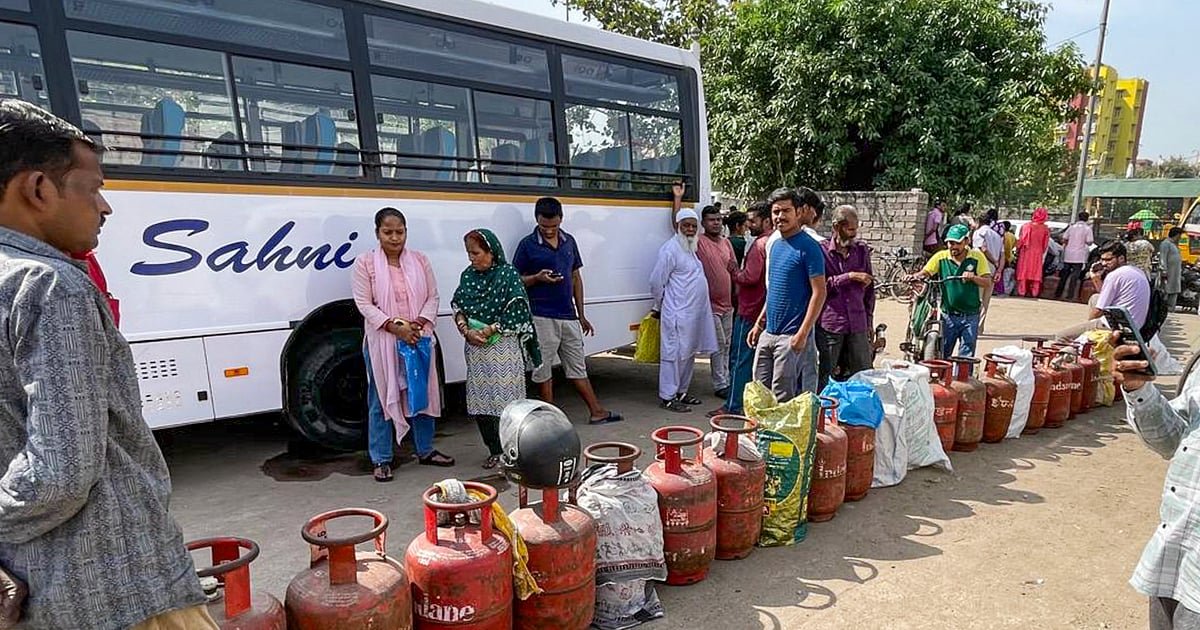

NEW DELHI: The small restaurants that are the backbone of the national capital’s foodie streets are losing their spark. Pushed by shortage of LPG and increase in prices on the black marketmany are being forced to reshape menus, cut staff and return to cooking with coal and wood.
For Neeraj Chawla, who has been running Vaishno Rasoi at Rajouri Garden for the past year after leaving a joint family structure, the struggle is financial and personal.
Closing up shop would make sense, he says, but it’s the fear of “beizatti” (shame) that keeps his stoves — now mostly coal and wood burning — burning, even as hope begins to flicker.
“Beizatti nahi ho ke band karke baith gaya hai, isiliye chala raha hoon (I keep it running to avoid the shame of closure),” Chawla said. PTIexplaining why it continues despite high operational costs and mounting losses.
Amid the West Asian crisis, the government has revised the order of priority for the distribution of domestically produced natural gas, putting LPG production alongside CNG and piped cooking gas at the top. This has led to an alleged supply crunch for hotels and restaurants that use commercial LPG at market prices.
With daily sales, which used to hover around Rs 12,000 on a good day, slipping further as coal and wood double cooking time and reduce efficiency, Chawla has already had to lay off two staff members.
From neighborhood staples like KK Da Dhaba in Tagore Garden, a stone’s throw from Chawla’s restaurant, to Khadak Singh Da Dhaba in Malviya Nagar, further out in the city, small restaurants are facing the same struggle.
Pankaj Dawar at KK Da Dhaba has gone back on the coals and removed fried items from the menu. Disappointment was written all over his face as he said: “No layoffs yet. But LPG prices on the black market are insane, beyond most people’s reach.”
People familiar with the situation said that a cylinder, usually priced between Rs 1,000 and Rs 1,500, is now being sold for anywhere between Rs 3,000 and Rs 4,500.
The situation is more worrying for Rajinder Singh Bhandari, owner of Khadak Singh Da Dhaba, who has not received LPG for a week.
“No non-veg, just a temporary tandoor stove. LPG mil hi nahi raha (can’t find LPG anywhere),” he says, adding that daily sales have fallen from Rs 30,000 to half.
Delhi Food and Supplies Minister Manjinder Singh Sirsa said the government has taken steps to address the issue by increasing distribution of cylinders. In a post on X, Sirsa said distribution of commercial LPG cylinders has increased from 20 percent to 50 percent of the average daily consumption.
He added that the government is taking strict measures to prevent black marketing and hoarding, while guaranteeing residents and businesses uninterrupted supply.
According to the minister, the allocation has increased from 1800 to 4500 cylinders (19 kg equivalent) per day.
To think that only small restaurants are bearing the brunt of the situation would be misleading. Franchise chains and plush cafes alike are in the same boat, scrambling for quick fixes to minimize losses and keep their kitchens afloat.
The sudden shortage of LPG has forced restaurants to rethink the way they cook, and Secret Ingredient, a consultancy company that advises restaurants, has been calling non-stop.
“We have been actively working with brands to identify reliable induction appliance partners, including solutions that can handle high-intensity formats like woks and bulk cooking,” said Sid Mathur, founder-director of Secret Ingredient.
“In addition, we are helping teams rethink menu design and preparation structures to reduce unnecessary gas dependence, either through smarter stacking, sequencing or redistributing certain processes to alternative heat sources,” he added.
Popular chains like RollsKing, trendy casuals like Bomba Pizzeria & Taqueria and high-end Moroccan-inspired restaurant Sorbo in Gurugram are adapting to these new realities.
Even Bomba’s signature items have felt the pinch. At its MG Road outlet, the Neapolitan pizza basics, known as gazara, are temporarily off the menu.
“Yes, the LPG shortage has affected us like everyone else in the industry. We are adjusting cooking processes, being more gas-conscious and reworking kitchen workflows to maintain quality and guest experience,” said Chef Alisha Mehra, founder of Bomba.
In Sorbo, the adaptation has been more radical.
Frying and steaming have switched to electric alternatives, the pizza oven now runs on apple wood and the clay oven uses lava stone to reduce gas use. Even iconic slow-cooked dishes like ‘Moroccan Lamb Tagine’ and ‘Truffle Mushroom Soup’ have been discontinued.
“These changes sustain operations without compromising quality,” said founder Bhagyesh Tekriwal, adding that the LPG crisis and rising prices have further eroded margins in an already tight industry.
RollsKing, too, with few alternatives in sight, has executed a rapid shift from fuel-powered to electric systems. The move, while necessary to continue operations, brought its own set of challenges.
“It hasn’t been completely smooth. Traditional gas tawas heat up and recover faster than electric hotplates, which has slowed down preparation times a bit and temporarily reduced order volumes. This is a short-term fix and as our teams get used to the electric systems, we expect service speeds to return to normal soon,” explained RollsKing co-founder Arjun.



