
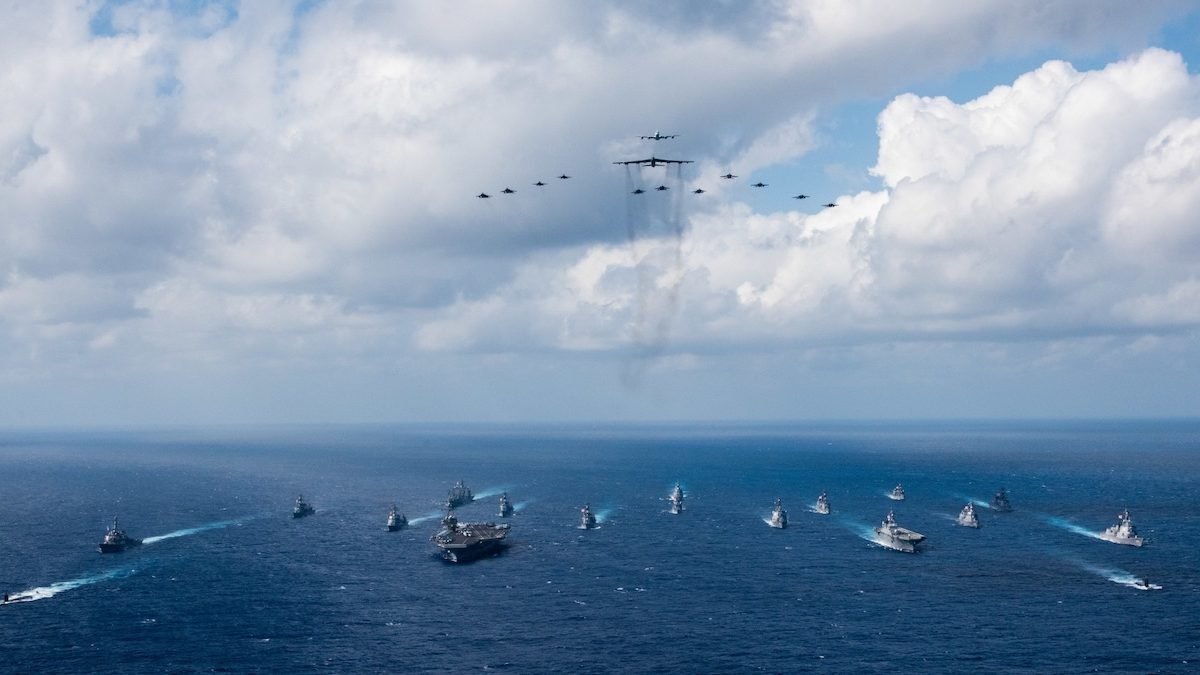

Strategy may be announced in documents, but ultimately it is tested at chokepoints. As shipping grinds to a halt, missiles go further than expected, and even the world’s most powerful fleet fails to navigate the waterways a day sailing from the base of the US Fifth Fleet, the core promise of the Indo-Pacific idea—that naval power can guarantee global order—has fallen.
From the start, the “Indo-Pacific” was less a coherent strategic framework than a conceptual stretch—a branding exercise designed to prop up an intellectually outdated maritime order. It brought together two oceans, multiple regions, and incompatible strategic cultures under a single label, not because they naturally formed a system, but because it served a particular purpose: to expand the reach of naval power in an age when that power was beginning to face structural limits.
Whose Indo-Pacific?
At its core, the concept reflects the strategic instincts of one actor above all others: the United States. It is a way of seeing the world as a continuous space of sea lanes, chokepoints and maritime mobility – a space where power is projected, alliances are networked and order is maintained by external water. The Indo-Pacific, in this sense, is simply the latest iteration of a long-standing American strategic habit: turning geography into a navigable theater for naval dominance.
For the United States, the Indo-Pacific made perfect sense. It extended the American strategic logic to a great maritime arc, connecting allies and partners in a network that could be accessed, reinforced, and supplied from the sea. It maintained the primacy of sea power as the organizing principle of the regional order. It allowed the U to remain a balancer on the high seas, shaping events without becoming territorially entrenched.
Over the past ten years, the US. tried to impose the same logic on actors and regions for which it makes much less sense.
Take India – the supposed anchor of “Indo” in the Indo-Pacific. India’s involvement has always been presented as a strategic move, connecting the Indian Ocean with the Pacific and creating a unified counterbalancing coalition against China. But this framing fundamentally misunderstands India’s strategic reality.
India is not, essentially, a maritime power. It is a continental power with maritime interests. Its main security concerns lie on the ground: its contested borders with China, its enduring rivalry with Pakistan, and its internal cohesion across a vast and diverse territory. Its strategic culture is shaped by these realities – by issues of territorial control, border stability and continental depth.
The Indo-Pacific does little to address these concerns. It offers India a role in a naval coalition, but offers no meaningful leverage in its main theaters of competition. It encourages maritime cooperation and participation in forums like the Quad, but these are peripheral to the central axis of Indian security. In effect, India is being asked to participate in a system that is not designed for its needs.
An Indo-Pacific concept lost at sea?
Over the past ten years, it has become increasingly clear that the Indo-Pacific concept rests on fragile foundations. He assumed that naval dominance remained the decisive factor in shaping regional outcomes—that control of sea lanes, naval superiority, and forward deployment underpinned the strategic order. With every sentence you read, this is changing.
As the United States struggles to secure passage through the Strait of Hormuz under constant threat — and its carrier strike groups, once symbols of dominance, operate within increasing range of Iranian missile ranges — the aura of uncontested naval superiority is beginning to fade. The geometry has changed: control no longer flows from the sea, but is contested – and often denied – from the land.
Across the Eurasian continent, the balance between naval attack and continental defense has shifted.
Advances in missile technology, air defense systems and long-range strike capabilities have made it increasingly costly – and dangerous – for naval powers to project force close to continental land masses. Anti-Access/Area Denial (A2/AD) systems are not simply tactical developments; they represent a structural change in power geometry.
Where once naval forces could approach, strike and retreat with relative freedom, they now face layered defense networks that stretch deep inland and out into adjacent seas. Penetration cost has increased. The margin of error has narrowed. The advantage goes to the defender.
At the same time, continental powers are strengthening their position through infrastructure, connectivity and economic integration. Rail networks, pipelines and overland trade routes are reducing dependence on maritime chokepoints. Strategic depth – once only a function of geography – is now being actively constructed.
The Indo-Pacific framework does not take this difference into account. It remains anchored in an earlier era, when maritime mobility could decisively shape outcomes on land. It assumes that the sea remains the primary domain through which energy flows. This is increasingly anachronistic.
There will be a significant reckoning across the region, especially in those countries that have taken the most of the concept: Australia and Japan.

Jeffrey Robertson is an academic, consultant and writer focused on foreign affairs, diplomacy and the Korean Peninsula. This article was originally published on him submarine, Junotaneand reprinted with permission.



