
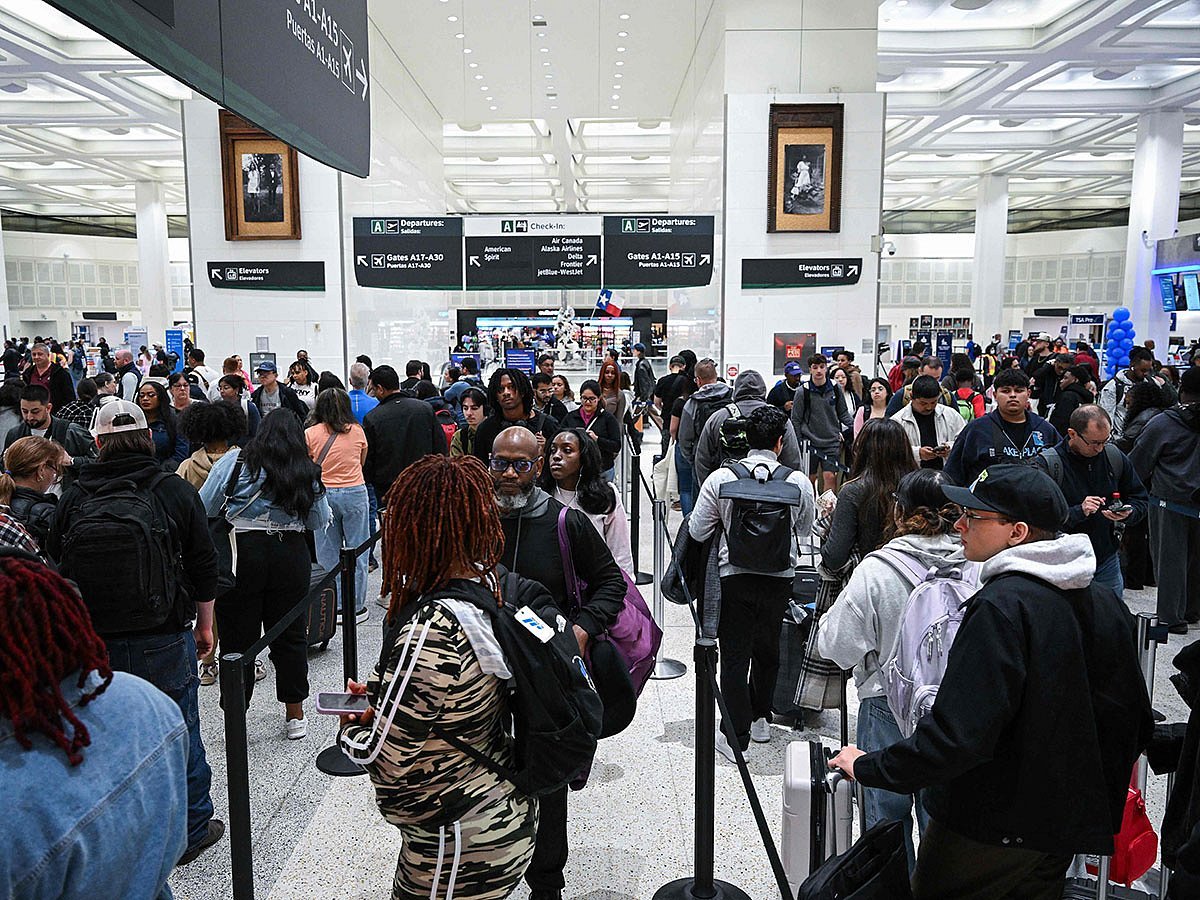

Long security lines stretching for hours, missed flights and growing frustration – US airports are facing widespread disruption as a funding freeze leaves key security operations understaffed at the height of the spring travel season.
The chaos has been compounded by wider pressures on global aviation, including the war in Iran, recent accidents and operational delays, creating a perfect storm for travellers. At some airports, passengers have reported waiting up to four hours to clear security, with some flights being missed entirely.
The situation has become so acute that President Donald Trump ordered Immigration and Customs Enforcement (ICE) officers to help with airport security — an unusual step that has sparked political debate and raised new questions about how the US manages aviation security.
What’s the real problem at US airports?
The immediate issue is severe congestion at airport security checkpoints caused by a shortage of staff at the Transportation Security Administration (TSA).
A National Transportation Safety Board official was stuck in a TSA line in Houston for three hours while trying to get to New York for an investigation, prompting officials to “beg” for expedited clearance, according to NTSB Chair Jennifer Homendy.
Passengers have reported similar delays. One traveler missed his flight after waiting four hours at security, while another lost a $500 deposit after repeated delays.
Why is there a budget crisis?
The shutdown stems from a funding impasse in Washington that has halted routine funding for parts of the Department of Homeland Security (DHS), including TSA operations.
The impasse is tied to disputes over immigration enforcement, particularly ICE’s role in deportation operations. Democrats have refused to fund DHS without limits on these activities, while Republicans have pushed to keep them.
Key Facts: US Homeland Security
-
Oversees national security functions including aviation, borders and immigration
-
The TSA handles passenger and baggage screening at airports
-
ICE focuses on immigration enforcement and deportations
-
Customs and Border Protection manages entry points and borders
-
Funding disputes can directly affect airport staffing and operations
-
The current budget impasse crisis over immigration enforcement
What does Homeland Security do?
The Department of Homeland Security oversees a wide range of functions related to national security, including aviation security, border protection, and immigration enforcement.
At airports, the TSA—which falls under DHS—is responsible for screening passengers and baggage to ensure safe travel. Any interruption in its funding or staffing has immediate negative effects on the airport’s operations.
Why are ICE officers being used instead of TSA staff?
In response to the staffing crisis, President Trump ordered ICE officers to help with airport security — a highly unusual move.
While ICE typically focuses on immigration enforcement and deportations, its officers are now supplementing TSA personnel at checkpoints.
The deployment has helped shorten lines in some cases, but has also raised concerns about the costs and suitability of using immigration officers for aviation security roles.
One passenger questioned the approach, saying, “The lines are shorter today. But in my mind, we can fund the TSA a lot less than we can to send ICE here, put them in hotels and all the things that go along with that.”
What is being done to fix the situation?
Lawmakers are now working to resolve the funding impasse, with senators debating a possible deal that would fund most DHS operations — including TSA — while excluding some of ICE’s enforcement activities.
Negotiations have intensified, with both sides signaling urgency.
American airport disruption at a glance
-
Up to 4 hours waiting time in some airport security lines
-
At least a 3-hour delay was reported to an NTSB official in Houston
-
About $500 was lost by one passenger due to delays
-
Over 23 recent disruptions that have affected aviation (storms, wars, accidents)
-
Thousands of passengers are affected every day by delays and long queues
Is this a long term problem?
Industry officials say the disruptions are temporary, though passengers may continue to face delays in the near term.
“The issues we’re dealing with today are really temporary,” said Airlines for America CEO Chris Sununu.
However, the crisis has exposed deeper weaknesses in the system – particularly how political gridlock can directly affect critical infrastructure such as airport security.
How are passengers affected beyond delays?
The disruption is going beyond concern.
Passengers miss flights, lose money on bookings and face uncertainty due to poor communication about delays. In one case, a traveler lost a $500 deposit after repeated flight delays.
The unpredictability is also increasing travel anxiety, even among frequent flyers.
Is this related to wider global tensions?
Yes — the airport disruption is unfolding alongside broader aviation pressures.
The Iran war has affected airspace use and planning, while recent accidents and operational disruptions have added strain on airline systems.
Together, these factors are compounding delays and reducing system resilience.
What happens if the funding freeze continues?
If no deal is reached, staff shortages could worsen, leading to longer queues and more flight disruptions.
Airports may continue to rely on temporary measures such as ICE deployments, but these are not seen as sustainable long-term solutions.
What is the long-term solution?
The immediate solution is to resolve the funding dispute to restore full staffing for TSA operations.
Longer term, experts say the system needs more stable funding mechanisms, better workforce planning and improved coordination between agencies to handle rising demand and crises.

Alex has been on the front lines of world titles for nearly 30 years. A veteran editor, he is part newsroom veteran and part Globe correspondent. His credentials? He was part of the select group of journalists who covered Pope Francis’ historic visit to the United Arab Emirates – flying with the Pope himself. With 27 years on the ground in the Middle East, Alex is one of the most trusted voices in the region when it comes to deciphering politics and power games. He breaks down global issues into brilliant 60-second news stories – his morning reels are practically a daily ritual for audiences across the UAE. Sharp. Based. Quickly. Understanding. This is Alex at his best, bringing a steady editorial hand to every story he tells.



